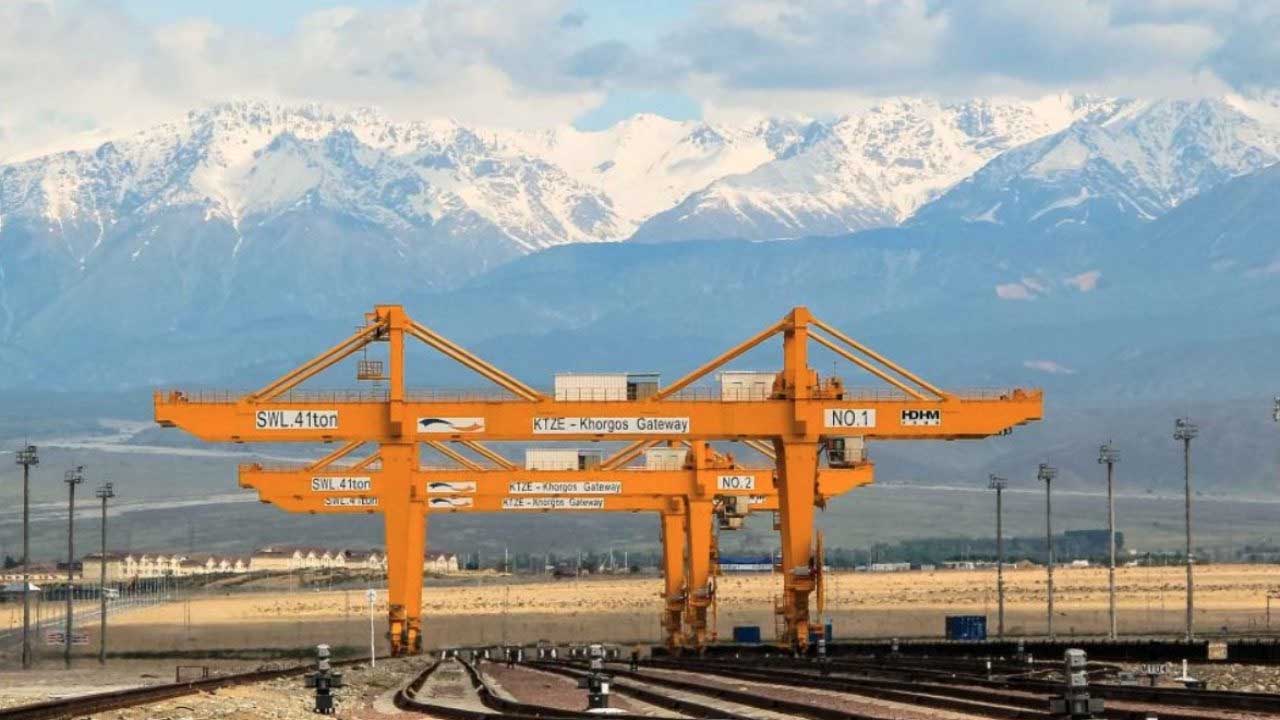
Khorgos – The World’s Largest Dry Port
In the middle of Central Asia’s desert belt, more than a thousand miles from any coastline, a vast logistics hub moves cargo between two continents. There are no ships, no harbors, and no ocean currents. Instead, steel tracks run toward the horizon, lined with cranes, freight yards, and warehouses built at a scale once unthinkable for this isolated frontier. A generation ago, Khorgos barely appeared on maps. Today, it stands as one of the world’s busiest inland ports and a strategic heartbeat of modern trade. I still remember the first time I saw satellite images of this place and realized how fast the world’s supply chains were shifting right through this stretch of desert.
Khorgos sits on the border between China’s Xinjiang region and southeastern Kazakhstan, in one of the most landlocked areas on Earth. Its surroundings look empty at first glance, but its position places it directly between two major rail networks that connect East Asia to Europe. This unlikely location became the foundation of a new trade system built through China’s Belt and Road Initiative, the largest infrastructure vision of the twenty-first century.
Khorgos represents much more than a dry port. It marks the return of Central Asia to the center of global commerce.
Also Read: Africa’s First High-Speed Rail: Egypt’s $23B Mega Project
A New Silk Road Through the Desert
Central Asia once thrived as the meeting point of cultures, caravans, and overland trade. Silk, ceramics, spices, and metals crossed deserts and mountain passes as merchants linked China and Europe. That era faded when maritime ports took over global shipping. For centuries, these inland routes fell silent, replaced by shipping lanes millions of tons of cargo now depend on.
Khorgos reopens a forgotten chapter. China saw the potential to rebuild land connections that could move goods faster than sea routes and reduce exposure to maritime chokepoints. Instead of starting with a historic hub, planners selected Khorgos precisely because the land was open, undeveloped, and positioned at a natural junction between two national rail grids.
This decision created the blueprint for the world’s largest dry port. Instead of ships unloading onto quays, trains roll across wide yards. Containers move across the desert at speeds that transform supply chain timing. Cargo that usually takes 40 to 45 days to travel by sea can now make the same journey in roughly 15 days by rail.
This corridor forms part of the New Eurasian Land Bridge, a rail network linking China’s manufacturing centers with major European markets. As disruptions and delays continue to affect global shipping, the Khorgos route has gained even more relevance for companies seeking predictable transit times.
Building a Logistics City From Nothing
On the Kazakh side lies Khorgos Gateway, the massive dry port and logistics complex that anchors this cross-border system. Directly across the boundary is the Khorgos International Centre for Boundary Cooperation, known as ICBC Khorgos. It functions as a shared free-trade zone where visitors from both sides can enter without visas, creating a rare economic space between two nations.
Together, these two zones reshaped what was once a barren stretch of steppe.
A key challenge was connecting Khorgos to existing rail lines. Kazakhstan built a 293-kilometre railway from Khorgos to Zhetygen, linking the new hub to the entire Central Asian and Russian rail network. China extended its western rail corridors to meet the border facility, tying the region directly into its national grid.
Daily operations reveal the scale of the transformation. Giant gantry cranes sweep across the yards, moving containers between trains with precision. Freight tracks radiate in multiple directions. Warehouses cover the desert floor, supporting cold storage, customs processing, and freight consolidation. At night, the complex glows like an industrial city, its movements synchronized by digital logistics systems.
By 2024, the port recorded more than 24,000 trains using the China-Europe rail routes annually, with Khorgos responsible for a large share of these crossings. Official data shows the port now handles millions of tonnes of cargo each year, and Kazakhstan has announced plans to expand capacity to match rising demand driven by rerouted European and Asian trade.
Khorgos didn’t simply emerge as a border checkpoint. It became a purpose-built logistics city engineered for constant motion.
Engineering Around a Critical Rail Problem
A major technical obstacle sits at the center of the dry port. China uses a rail gauge of 1,435 millimetres. Kazakhstan, along with Russia and much of Central Asia, uses a broader 1,520-millimetre gauge. Freight trains cannot cross the border without adjustment.
Instead of changing wheels or bogies—a slow and labor-heavy process—Khorgos relies on high-speed container transfers. Massive cranes lift containers from one gauge of train and place them onto the other. Advanced software coordinates train arrivals so that full sets of wagons cycle through the terminal with minimal delay.
A full container train can be transferred in roughly 47 minutes, turning what could have been a crushing bottleneck into a streamlined handoff. The system’s reliability has become one of the reasons shippers trust the Khorgos route for time-sensitive goods like electronics, machinery, auto parts, and textiles.
This solution shows how engineering can reshape the limits imposed by geography and legacy infrastructure.
A New Urban Frontier Emerges
Trade alone didn’t stay contained within the port. Around Khorgos Gateway, a new city has started to rise. Roads, government buildings, residential districts, and commercial zones now anchor what used to be empty desert. Workers from China, Kazakhstan, and neighboring states live here. Schools, shops, cultural centers, and logistics services support a growing population.
The ICBC free-trade zone draws traders from both sides of the border. Small businesses sell textiles, electronics, agricultural goods, and manufactured items. It is one of the only international commercial zones in the world where two countries share a border facility without requiring visitors to obtain visas.
Kazakhstan continues to promote the city as part of its long-term plan to diversify its economy beyond natural resources. The government has announced new housing, energy facilities, and industrial parks near the port to attract manufacturing and value-added industries.
In less than two decades, a once-silent landscape has turned into an economic corridor filled with cranes, markets, and expanding neighborhoods.
Strategic Stakes Behind the Port
Khorgos carries geopolitical weight that stretches far beyond cargo numbers. China views the port as a safeguard for overland trade routes that reduce reliance on maritime paths vulnerable to conflict, piracy, or political tension. Kazakhstan sees it as a central pillar in its goal to become a leading transit nation and a bridge between East and West.
This growth shifts economic alliances. Countries across Eurasia are recalibrating their partnerships based on rail access, investment flows, and supply chain dependencies. Khorgos stands at the center of discussions about regional influence, debt sustainability, and long-term infrastructure commitments.
Even with these concerns, trade through Khorgos continues to expand. Rail shipments have risen sharply due to congestion in global shipping, pressure on supply chains, and the search for alternatives to traditional sea routes. International logistics firms now consider the Khorgos corridor a vital option for balancing risk and improving delivery times.
A New Centre of Gravity in Global Trade
Khorgos challenges long-held assumptions about the dominance of ocean ports. It demonstrates that inland transport corridors can redirect the flow of goods and create new economic centers far from the coast. By linking inland production zones directly to European markets, Khorgos delivers a supply chain model that bypasses thousands of kilometers of sea travel.
As global industries adapt to shifting demand, manufacturing diversification, and political pressures, routes like Khorgos offer resilience. Companies gain another path for shipments. Nations gain new leverage. Regions once considered remote gain influence across continents.
This is not the Silk Road preserved in history books. It is a functioning system built on steel, concrete, and coordination.
Also Read: Egypt’s New Capital Is a Disaster Waiting to Happen
A Future Shaped by Connection
Khorgos proves that trade patterns can evolve faster than geography. In the middle of Central Asia, a new center of global logistics now stands where there was once only dust and wind. The rise of this port shows how infrastructure can redraw economic maps, create new urban centers, and link entire regions through rail corridors.
Khorgos is more than a dry port. It is a gateway built on land, powered by movement, and connected to markets thousands of kilometers away. It marks the return of Central Asia as a bridge between worlds, turning a once-forgotten border into one of the most strategic points on Earth.