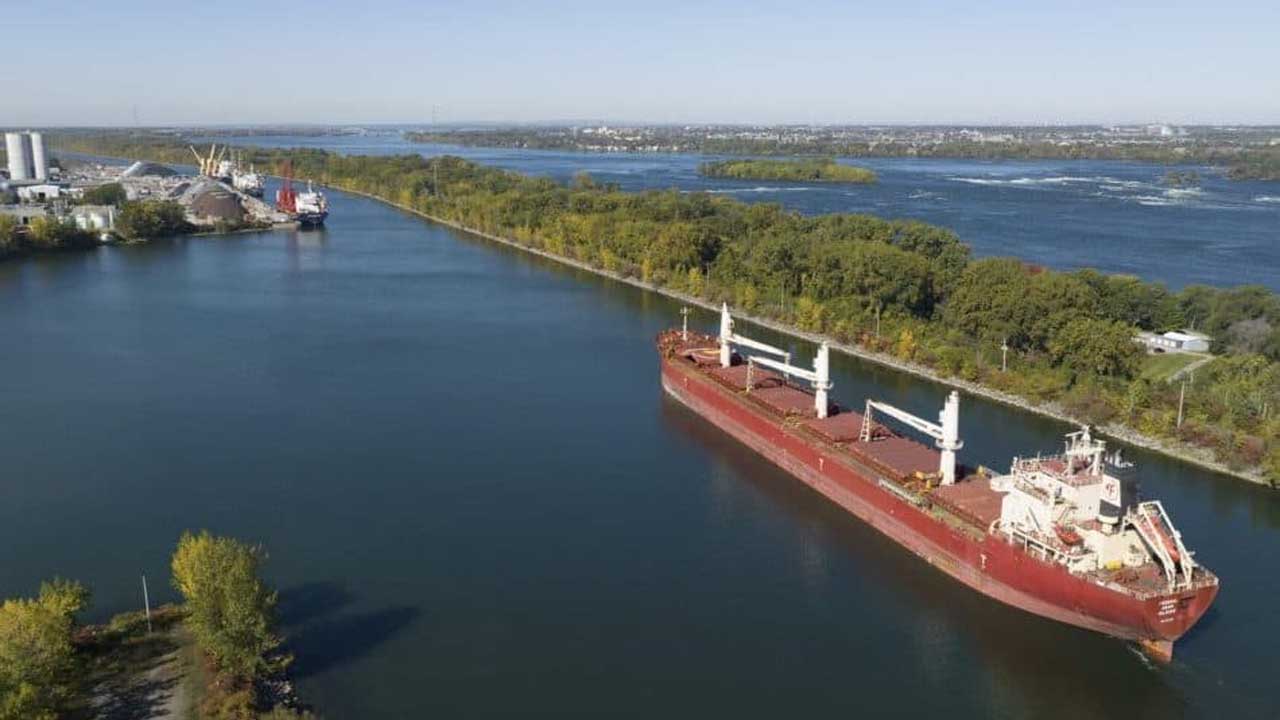
The $8.4 Billion Rescue of the St. Lawrence Seaway
The St. Lawrence Seaway stands as one of North America’s most powerful engineering achievements. This single waterway carved a direct path between the Atlantic Ocean and the industrial core of Canada and the United States. For more than 65 years, it has carried raw materials, agricultural harvests, and heavy industrial cargo that shaped cities, built factories, and supported entire communities. When I first watched a fully loaded bulk carrier slide through its narrow concrete locks, I felt the raw scale of this system in my chest. I realized I wasn’t looking at a canal. I was witnessing an artery that keeps two nations breathing.
Today, the Seaway faces the hardest challenge in its history. Aging structures strain under constant use. Trade patterns change at a relentless pace. Climate stress alters water levels that engineers once considered predictable. To protect this lifeline, Canada and the United States launched an unprecedented $8.4 billion modernization effort that aims to secure the system for the next century of global trade.
Origins Forged by Natural Barriers
In the early nineteenth century, the St. Lawrence River offered both opportunity and resistance. It connected the interior of the continent to the Atlantic, but violent rapids near Montreal blocked ocean-going vessels. Trade stalled where water boiled over exposed rock. Engineers answered the challenge with bold construction.
In 1825, workers completed the Lachine Canal. The 14-kilometer bypass carved through solid ground and allowed ships to pass around the rapids. This achievement reshaped regional commerce. Timber, grain, and iron suddenly flowed at scales that local economies had never experienced.
Also Read: Inside California Forever: Billionaires’ $900M Secret City
Another obstacle rose farther west. Niagara Falls blocked any continuous route between Lake Ontario and Lake Erie. Canada responded with the Welland Canal. In 1932, engineers completed its modern lock system, which lifted ships nearly 99 meters across eight massive chambers. The canal established vertical ship movement as a core engineering feature of the waterway system.
These projects laid the foundation for a continental corridor. They proved that precise engineering could conquer natural barriers that had limited trade for centuries.
The 1959 Breakthrough
By the mid-twentieth century, Canada and the United States reached an ambitious decision. They would unite existing canals and river modifications into one navigable corridor stretching 3,700 kilometers deep into the Great Lakes. Both nations collaborated on dredging, new lock construction, and coastal reshaping that advanced maritime logistics across a scale unseen in North America.
The St. Lawrence Seaway officially opened in 1959. Its locks accepted oceangoing ships up to 233 meters long, 24 meters wide, and with drafts approaching 9 meters. Grain elevators across the Midwest suddenly gained direct access to European ports. Iron ore shipped from Canadian mines flowed straight into steel mills along the American shoreline. Manufacturing supply chains tightened. Export volumes surged.
Canada moved rapidly into its position as a global resource supplier. American industries expanded their reliance on inland shipping. The Great Lakes became an extension of the Atlantic transportation network. Cities like Duluth, Hamilton, Cleveland, and Thunder Bay thrived on the steady movement of commodities driven through the waterway.
Seawaymax Limits and the Changing World
As global shipping advanced, vessel size expanded far beyond what mid-century engineers predicted. Container ships and new bulk carriers grew longer, wider, and deeper. Ports worldwide expanded channels and replaced infrastructure to accommodate these giants.
The Seaway operated under strict physical dimensions known as Seawaymax limits. Ships could measure no longer than about 226 meters, no wider than 23.8 meters, and draw no more than 8.2 meters of water. Modern container vessels often exceed twice these dimensions.
The shipping industry shifted toward scale efficiency. Mega-ships reduced per-ton transport costs. The Seaway could not physically support them. Cargo volumes began to decline as global firms rerouted supply chains toward deeper coastal ports and rail corridors.
Despite this trend, the system still moved approximately 142 million tonnes of cargo in 2024. This activity included grain, iron ore, coal, salt, cement, and project cargo that required specialized handling. The Seaway maintained relevance for heavy bulk movements that demand inland water transport efficiency.
Aging Infrastructure Under Stress
Most structural elements of the Seaway date to the 1950s. Locks operate with original steel gate mechanisms. Concrete walls endure relentless freeze-thaw cycles that induce cracking. Ice flows grind against harbor breakwaters every winter. Decades of mechanical wear strain hydraulic systems designed for a very different operational environment.
Maintenance now costs exponentially more than in earlier decades. Ship delays rise as mechanical failures increase. After years spent trading on reliability, industries now calculate extra time margins for Seaway shipments.
Environmental pressures compound these engineering challenges. Ballast water released from international shipping introduced invasive species into the Great Lakes. Zebra mussels, sea lampreys, and spiny water fleas disrupted native ecosystems and food chains.
Climate variation added another dimension of risk. Water levels fluctuate sharply across seasons. Storm intensity increased. Ice coverage forms unpredictably and breaks faster than historical models predicted. These changes increase navigational hazards and place pressure on lock schedules that depend on stable operational assumptions.
Without intervention, the waterway faced declining safety margins and growing trade loss.
The $8.4 Billion Modernization Campaign
In 2018, Canada and the United States committed to the most comprehensive infrastructure sweep in the Seaway’s history. The $8.4 billion program spans port upgrades, ship fleet renewal, lock modernization, automation deployment, and environmental controls that aim to maintain competitiveness for decades.
Public records confirmed that by late 2024, crews completed more than $636 million in vessel modernization projects. Additional allocation of $328 million moves toward ice-class upgrades and hull retrofits that enhance all-season reliability.
Port authorities across the corridor received over $2.1 billion for berthing expansions, crane installation, dredging maintenance, secure storage upgrades, and modern cargo handling equipment. Future stages include another $1.1 billion in approved development, focused on deeper draft accommodations and climate resiliency improvements.
Core infrastructure projects consume the largest share of funding. Approximately $3 billion supports lock refinements, concrete replacements, breakwater stabilization, and channel scour control. Another $1.2 billion funds engineering assessments and construction preparation for next-phase expansions.
These upgrades do not simply preserve past designs. They integrate new automation and precision systems that push Seaway operations into contemporary logistics standards.
Technology and Environmental Transition
Mechanical mooring arms replaced manual line systems in most major locks. These steel arms secure ships within seconds and hold them steady throughout lock filling. The new systems reduce accidents and allow faster vessel processing.
The Voyage Information System now links vessel movement scheduling with real-time weather, ice mapping, and water depth data. Operators adjust transit speeds and sequencing dynamically to maximize safety and minimize fuel use.
Hydropower stations along the Welland Canal contribute clean electricity to regional grids. In 2024, estimates confirmed that hydropower along the system prevents more than 38,900 tons of carbon dioxide emissions annually.
Since 2005, data from the St. Lawrence Seaway Management Corporation documented a 69 percent reduction in operational carbon emissions. This surpasses Canada’s official national reduction targets set for 2030. These reductions reflect fleet modernization, route optimization, cleaner fuels, and infrastructural efficiency gains.
An Economic Engine
The Seaway anchors a continental economy valued near $6 trillion. Analysts rank the Great Lakes St. Lawrence economic zone as a financial block comparable to the world’s largest national economies.
Annual Seaway contributions reach roughly $36 billion across Canada and the United States. More than 240,000 jobs connect directly or indirectly to Seaway commerce, from dockworkers to steel producers and agricultural exporters.
Bulk shipping remains one of the lowest-emission transportation options per ton moved. Rail transport costs more. Highways add congestion and pollution. Inland shipping keeps heavy cargo movement both affordable and environmentally responsible.
For you as a reader, these numbers translate into daily stability. Construction materials arrive on schedule. Food exports remain competitive. Heavy manufacturing maintains pricing control.
A Network of Strategic Waterways
The Seaway intersects with major inland corridors that keep North America’s industrial regions connected.
The Soo Locks between Lake Superior and Lake Huron carry over 80 million tonnes of freight annually. A $3.2 billion new lock project drives construction at the site to increase capacity resilience against mechanical failure. The new facility strengthens reliability for iron ore shipments critical to U.S. steel supply chains.
The Illinois Waterway extends 336 miles into the central United States through eight lock systems. It accommodates vessels matching Seaway dimensions and reduces annual logistics costs by an estimated $3.6 billion across agricultural and material transport networks.
Together, these arteries form one of the largest inland maritime systems on Earth.
The Future at Stake
The modernization push aims to preserve relevance amid shifting shipping practices. Ultra-large container carriers will never pass Seaway locks. The system instead builds strength around bulk material efficiency, green transport leadership, and supply chain resiliency.
The central challenge lies in engineering adaptability under climate uncertainty. Engineers now build reinforced structures capable of handling varied ice behavior and fast-changing water levels. Environmental research efforts continue around invasive species management and ballast filtering standards.
For me, watching the steady reconstruction unfold brings a profound sense of respect. I stand on these lock walls knowing that every crane move and concrete pour supports millions of livelihoods on both sides of the border.
Also Read: The World’s Tallest Dam: Inside Tajikistan’s $6 Billion Megaproject
The Meaning of the Rescue
The St. Lawrence Seaway represents ambitious civil engineering at its finest. It reflects centuries of persistence that reshaped one of the world’s most complex freshwater systems to serve industry, communities, and international trade.
This $8.4 billion rescue mission stands as the largest transformation effort since the waterway opened in 1959. Engineers work not to chase the largest ships but to secure reliable transport that remains safe, efficient, and environmentally responsible.
The coming decades will reveal the success of this strategy. The choices made today will determine if the Seaway remains an active artery of continental commerce or fades into historical memory.
I walked its docks and watched the gates close behind a rising vessel. In that moment, I felt the full weight of what is being protected.