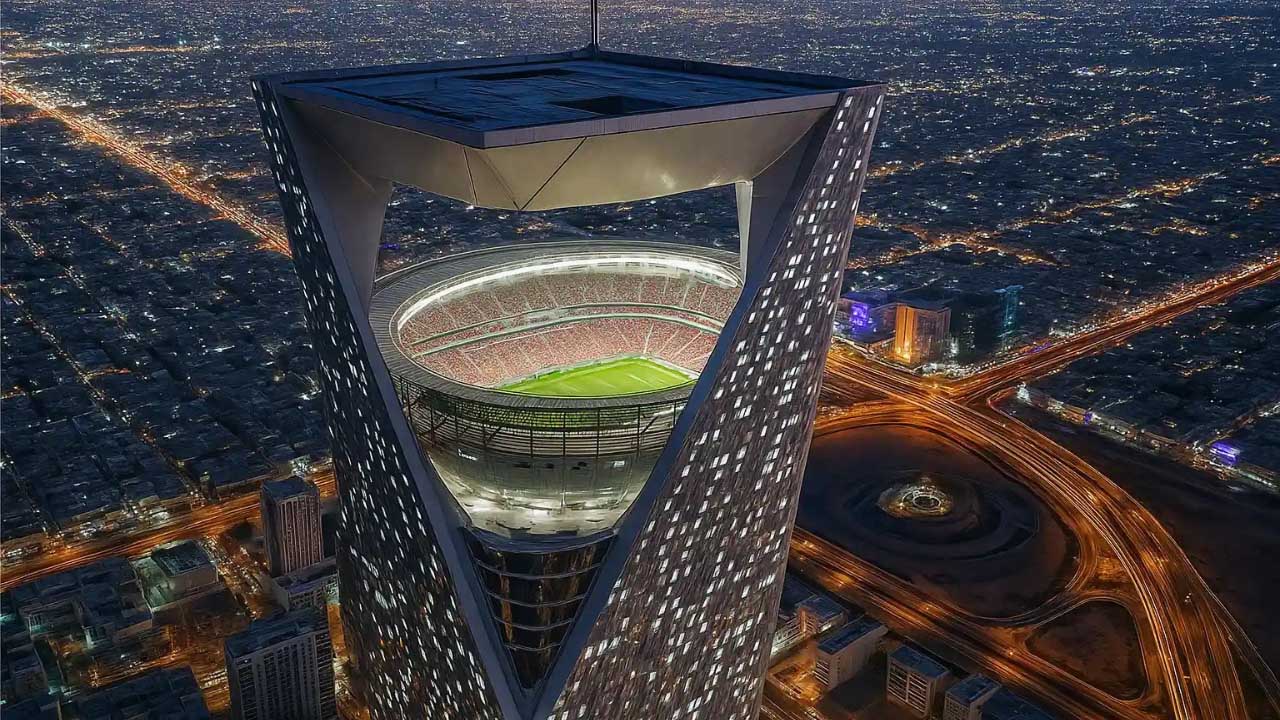
NEOM Sky Stadium – The $1 Billion Stadium in the Sky
The idea of watching a World Cup match from a stadium suspended in the air sounds impossible until you see the plans for the NEOM Sky Stadium. Saudi Arabia intends to lift the experience of live sport to a height of 350 meters, placing fans inside an arena that rises above the desert like a floating monument. No sprawling car parks, no endless queues, and no traditional footprint on the ground. Instead, the stadium sits inside The Line, the country’s most ambitious urban development. It represents a shift in how nations present themselves to the world, and it captures a sense of boldness that I felt instantly when I first studied the plans up close.
The Vision Behind the Project
Saudi Arabia has set out to reshape its global identity, and the NEOM region stands at the center of that mission. Vision 2030, the country’s long-term transformation plan, aims to diversify the economy, build new industries, and create destinations that attract global attention. Sport plays a central role in this strategy. The Kingdom has already hosted Formula 1, major boxing events, esports tournaments, and golf championships. Securing the 2034 FIFA World Cup marked a turning point, signaling a commitment to build venues that reflect the scale of its ambitions.
The NEOM Sky Stadium sits at the top of this list. Saudi Arabia plans multiple venues for 2034, including the King Salman International Stadium in Riyadh and the new Prince Mohammed bin Salman Stadium in Qiddiya. Each project showcases design and engineering that push the limits of traditional sports architecture. Yet none challenge convention as directly as the Sky Stadium, which is designed not on land but suspended hundreds of meters above it, giving Saudi Arabia a signature landmark unlike anything else in the world.
Also Read: Inside OpenAI’s $500 Billion AI Megaproject (Stargate)
A Stadium Suspended in the Sky
The Sky Stadium will rise 350 meters above the desert floor, placing it at nearly the same height as New York’s Empire State Building. Instead of standing alone, it will sit within The Line, NEOM’s most recognized megaproject. The Line is a 170-kilometer linear city designed to hold up to 9 million residents within a narrow vertical structure. It integrates homes, offices, parks, transit, and public spaces in a compact, efficient layout supported by renewable energy.
The stadium will serve as one of The Line’s central gathering points, positioned inside a canyon of mirrored walls that reflect the surrounding landscape. Transportation into the arena will run vertically and horizontally through The Line’s internal mobility system. Fans will travel using electric pods, automated shuttles, and high-speed elevators rather than cars or buses. By merging the stadium into the superstructure, designers aim to eliminate many of the problems associated with conventional venues, including traffic congestion, long entry routes, and disconnected urban footprints. It introduces a vertical model for stadium placement that could influence future megacities.
Engineering and Construction
Building a stadium of this nature demands engineering far beyond traditional sports venues. The NEOM Sky Stadium carries an estimated cost of $1 billion, placing it among the most expensive stadium projects per seat anywhere in the world. Construction is planned to begin in 2027, with completion expected before 2032 so the venue can be fully tested before the World Cup. The project is being developed in partnership with NEOM, the Public Investment Fund, and the Ministry of Sport, alongside global engineering firms experienced in extreme-load structures and seismic modeling.
The stadium will not rely on standard foundations. Instead, it will be anchored into The Line’s structural spine using massive composite columns and reinforced load-bearing frameworks that distribute weight vertically across several tiers. Engineers are studying materials such as ultra-high-performance concrete, carbon fiber composites, and anti-vibration systems that manage sway and aerodynamic forces at high elevations. Building an arena for tens of thousands of spectators requires an extraordinary margin of safety, which is why the project includes layered redundancy in every structural system.
Wind modeling, crowd movement simulations, and emergency evacuation planning are already in development. These studies ensure the structure remains stable under extreme weather conditions and high-impact loading. The stadium’s suspended design requires precise coordination between architects, structural engineers, and safety authorities to meet international standards.
Design and Architecture
The NEOM Sky Stadium is envisioned as both a sporting venue and an artistic statement. Its exterior is wrapped in mirrored materials similar to The Line’s façade. During the day, reflections from the desert dunes and sky make the stadium appear as though it blends into the horizon. At night, thousands of LED points illuminate the structure and produce patterns that interact with the arena’s geometry. The result is a venue that changes character depending on time of day and atmospheric conditions.
The roof, inspired by crystal-like formations, uses layered panels that filter and direct sunlight to maintain comfort inside the seating bowl. Designers aim to control glare and heat gain through responsive shading systems and airflow channels built into the structure. Inside, the seating arrangement follows a beehive-inspired pattern. This arrangement ensures clean sightlines and optimal acoustics, allowing sound to travel smoothly through the arena. A capacity of around 46,000 seats places it among mid-sized World Cup venues, yet its vertical placement and immersive interior make the experience feel more intense and enclosed.
Every design decision supports the idea of a stadium embedded into a living city rather than occupying isolated land. It demonstrates a new architectural language for sports facilities, especially in regions facing land scarcity or extreme climate conditions.
Technology and Sustainability
The Sky Stadium will operate on renewable energy delivered through NEOM’s integrated grid, which draws from solar, wind, and green hydrogen sources. Real-time energy management systems will regulate lighting, cooling, and event operations to reduce waste and respond to environmental changes across the day. The entire mobility network serving the stadium will be electric, eliminating vehicle emissions around event days.
Inside the venue, digital infrastructure will enhance the experience for fans. Augmented reality systems may overlay live analytics, replays, or player stats onto personal devices without obstructing the view. Navigation tools will guide visitors from their entry point directly to their seats. Water conservation systems, including advanced greywater recycling and smart irrigation for surrounding public areas, support NEOM’s broader goal of achieving net-zero environmental impact across its districts.
These technologies position the stadium as a research platform for urban sustainability as much as a sports arena.
The 2034 FIFA World Cup
Saudi Arabia intends to use the Sky Stadium for major matches during the 2034 FIFA World Cup. With a capacity and location ideal for global broadcasts, it is expected to host games from the early stages through the quarterfinals. The Kingdom’s broader stadium development includes the 92,000-seat King Salman International Stadium, the iconic Prince Mohammed bin Salman Stadium carved into the cliffs of Qiddiya, the desert-framed New Murabba Stadium in Riyadh, and the vortex-inspired Aramco Stadium in Al Khobar.
These venues represent over $20 billion in investment and mark the most extensive World Cup stadium program ever undertaken. The Sky Stadium stands out because it challenges the idea of what a stadium should be. Rather than expanding outward, it rises upward, redefining how sports infrastructure fits into urban development.
Beyond the World Cup
The Sky Stadium is designed as a permanent feature of NEOM. Its purpose extends far beyond a single tournament. It will host concerts, cultural festivals, esports events, international club matches, and community gatherings. The concept allows residents and visitors to access the arena directly from nearby apartments, hotels, and public spaces built on multiple levels. This approach merges entertainment and urban life in a compact environment.
NEOM planners envision a district where a visitor could stay in a vertical hotel, ride an elevator to the stadium entrance, watch a match, dine within the same structure, and return to their residence a few floors above. The integration between city and stadium shifts how communities interact with large venues and may influence future designs across the world.
Public Reaction
Reactions to the Sky Stadium vary widely. Supporters believe it represents a bold step toward future cities and a practical solution for building in vertical environments. They view it as a sign that Saudi Arabia is ready to lead global architecture into new territory. Many architects have praised its ambition and the willingness to attempt something few countries would even consider.
Skeptics highlight several concerns, including:
- Structural vibration
- Crowd safety
- Emergency evacuation
- Long-term maintenance
Environmental experts also question the embodied carbon footprint of constructing such a structure, even if operations remain net-zero. Despite these debates, construction across NEOM continues, and global interest remains high. Whether the stadium becomes a fully realized venue or shifts through new design stages, it reflects the Kingdom’s intent to push architectural boundaries.
Also Read: No Workers, Just Robots: Inside the World’s Largest 3D-Printed Dam
Conclusion
The NEOM Sky Stadium captures a moment in history when nations are willing to rethink the way cities, sports, and technology come together. A $1 billion arena suspended in the air suggests a new form of architectural storytelling, where engineering and imagination meet to create experiences that once seemed unreachable. If completed as planned, it will redefine how fans interact with sport and how cities integrate their major landmarks.
Projects like this challenge the limits of what we believe is possible. As I look at the evolving plans, I see more than a venue for matches. I see a question rising above the desert, asking how far humanity is prepared to go in shaping the spaces where we gather, celebrate, and dream.