
King Salman Park: Inside Riyadh’s 16 km² Green City Project
A vast stretch of dry land in the center of Riyadh is being reshaped into one of the largest urban parks ever attempted. Tree-lined paths, lakes, gardens, cultural districts, and new neighborhoods are rising across 16 square kilometers of space once dominated by heat, dust, and concrete. King Salman Park stands five times larger than Central Park in New York, and its estimated cost of 9.4 billion dollars places it among the most ambitious city-building projects in the world. I walked through early sections of the site during a recent visit, and the sense of scale felt overwhelming in a way video alone cannot capture.
A New Face of Saudi Arabia
For decades, public life in Saudi Arabia followed a private rhythm. Entertainment was limited, communal events were rare, and daily life moved through a structured set of social expectations. Cinemas remained closed for more than 35 years. Social gatherings often separated men and women. The country’s global image leaned toward restraint rather than openness, and even everyday cultural expression lived quietly behind closed doors.
That identity started to shift with the launch of Vision 2030 in 2016. The strategy aimed to reduce dependence on oil, but it also reshaped the social environment. It encouraged community life, public culture, and shared experiences. Cinemas reopened. Outdoor festivals filled city streets. Millions of residents attended concerts, sports events, and fairs that once felt impossible. Women entered the workforce at record speed and now make up over one-third of the national labor participation, a rise with few global parallels.
King Salman Park captures this shift in physical form. It offers a place where daily life connects rather than separates, where families walk, young people gather, and culture becomes something people experience together. The park expresses a new chapter in Riyadh’s story, one where the outdoors becomes a shared living room for an entire city.
Also Read:Inside Google’s $2.1B New York Office | A Historic Train Station Turned Tech Hub
A City Within a City
The scale of the project becomes clearer when you look at the site’s location. King Salman Park sits on the former Riyadh Air Base, directly in the heart of the capital. Few global cities have reshaped their center at this magnitude. The 16 square kilometers are planned as a blended district of landscapes, cultural nodes, and new residential areas.
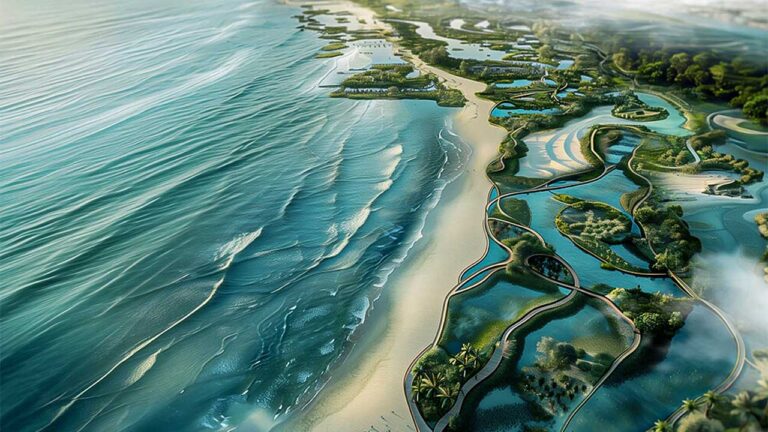
Designers planned the layout so that nearly 70 percent of the space becomes green. More than a million trees will eventually grow here, forming shaded pathways in a city where summer temperatures climb past 45 degrees Celsius. These trees are selected for drought resistance and long-term sustainability, supported by advanced irrigation systems fed by treated water.
Water shapes the experience as much as vegetation. The master plan includes over 300,000 square meters of water bodies, including lakes, ponds, streams, and recreation-friendly wetlands. These features cool nearby air and create microclimates that make outdoor activities possible during the warmer months. Riyadh’s climate has long limited public outdoor life, and these engineered water systems offer a solution grounded in both landscape design and environmental science.
A seven-kilometer circular walkway forms one of the project’s core spines. It links neighborhoods, plazas, gardens, and cultural zones. Instead of isolating districts from each other, the loop encourages walking as a primary mode of movement. It supports a shift away from car dependency, which has shaped Riyadh’s urban form for decades.
A standout element is the new valley system inspired by the desert wadis that shape the region’s natural topography. Engineers created long, sunken green corridors that guide breezes and pull cooler air inward. These valleys reduce surface temperatures, create continuous shade, and make walking comfortable in ways that typical parks cannot replicate in such a climate.
The result is not a single park. It is a living district woven into the structure of the city.
The Royal Arts Complex and Riyadh’s Cultural Core
At the heart of King Salman Park rises the Royal Arts Complex, one of the largest cultural districts ever built in the Gulf. Covering half a million square meters, the complex brings together museums, studios, creative workshops, galleries, and performance venues. It aims to build a broader cultural economy by giving artists, performers, and audiences a central place to interact.
The Museum of World Cultures anchors the district. Its triangular tower climbs 110 meters into the skyline, becoming one of Riyadh’s most recognizable silhouettes. Inside, the museum will host exhibitions that connect global civilizations, ancient heritage, and modern cultural expression.
Beside it, the National Theatre seats 2,300 people and can host international concerts, plays, and large-format productions. Riyadh lacked such venues for most of its modern history, and this new theater signals how cultural life is being reintroduced into the city at a scale that rivals major capitals.
Nearby, the Visitor Pavilion spans 90,000 square meters and uses Salmani architectural principles. These principles blend Riyadh’s historical character with modern form, giving the building a sense of place rooted in Saudi identity. From its rooftop, the full length of the park stretches into the distance, framed by gardens and water.
These facilities do more than host events. They redefine how culture enters public life, making it accessible, regular, and central to the city’s routine.
Living and Leisure in a New Urban Landscape
The park introduces a new model for living in Riyadh. More than 12,000 homes will sit within or beside the park’s green corridors. Residents will walk to plazas, cafés, gardens, and cultural spaces rather than relying on long drives across the city. This human-scale approach differs sharply from the car-oriented neighborhoods built in previous decades.
Sixteen hotels will serve visitors, including eco-lodges near the lake areas and premium hotels integrated into cultural districts. Shops and dining areas spread across half a million square meters add a lifestyle dimension comparable to major global destinations.
Recreation forms another core layer. An 850,000-square-meter golf course stretches across the eastern edge. Running tracks, cycling routes, multi-sport courts, climbing zones, and community fitness centers appear throughout the plan. A skydiving center adds an unexpected dimension that aligns with the country’s growing interest in adventure tourism.
Every element feels connected. Instead of separate districts, the park uses its landscape as the organizing structure, so leisure, culture, and daily life merge naturally.
Engineering, Infrastructure, and Construction Progress
Construction officially began in 2021, and major progress is now visible both on the ground and through satellite imagery. The primary valley corridors have taken shape, tree planting continues in multiple zones, and foundations of the cultural buildings are rising.
One of the most significant engineering achievements so far is the completion of a 2.4-kilometer underground tunnel in 2024. This tunnel reroutes a major roadway below the park. By moving traffic underground, the project preserves a continuous landscape at the surface. Only a handful of cities in the world have attempted such large-scale road restructuring as part of a park project, making this a notable milestone.
The estimated 9.4-billion-dollar investment includes phased construction. Early gardens and public walkways are expected to open in 2026. Full completion will unfold across several years, shaped by planting cycles, building timelines, and infrastructure sequencing.
This is not a short-term showcase. It is a structural redesign of Riyadh’s urban center.
Symbolism and What Comes Next
King Salman Park signals a shift in how Saudi Arabia defines public life and national identity. It expresses a desire to create shared spaces where culture, recreation, and social connection become part of everyday routines. Public parks often reveal the values of a city, and in this case, the message is clear: Riyadh is moving toward openness, gathering, and community-oriented design.
The country still faces challenges. Political authority remains centralized. Expression remains controlled. Social changes unfold unevenly. Yet urban environments often show future direction long before policy does. When a nation invests in green space, walkability, public culture, and environmental resilience, it signals confidence in its social transition.
Here, the desert is not being covered. It is being reimagined.
Riyadh is shifting from a city defined by heat, distance, and car travel to one defined by movement, culture, shade, and shared experience. King Salman Park stands at the center of that transformation.
Also Read: US Challenges China’s Grip on Africa with $1.7B Railway Project
A Changing Capital
So the real question is not whether this park will succeed as a green destination. The deeper question is what kind of city Riyadh becomes because of it. Time will reveal how people use these spaces, how culture grows inside them, and how the next generation sees its city.
For now, one truth feels certain. A new kind of urban life is emerging in the capital, and it is reshaping the identity of Riyadh from its core outward.