Dubai Creek Tower: The Tallest Vision That Stopped Midway
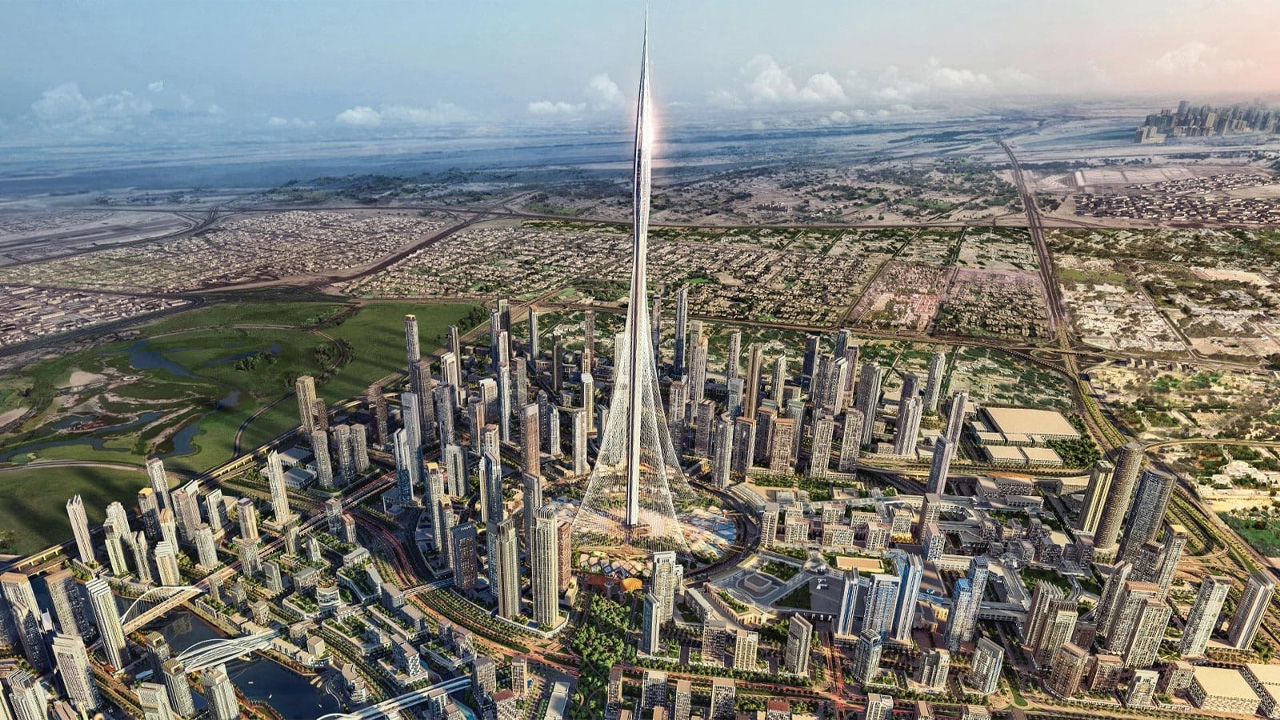
In 2016, Dubai set its sights on the sky once again. The city announced a tower that aimed to rise beyond the Burj Khalifa, beyond 828 meters, and beyond every structure ever built. Dubai Creek Tower promised more than height. It promised a statement. A slender, glowing structure would rise from the desert, held by steel cables and designed to redefine the skyline. The ambition felt real, bold, and unstoppable. Then the silence came. Construction slowed. The skyline stayed unchanged. Nearly a decade later, the site still stands unfinished. I remember looking at the early visuals and feeling certain that Dubai was about to change the limits of engineering once again.
A Bold Vision Designed to Outreach the Burj Khalifa
Emaar Properties revealed Dubai Creek Tower in April 2016 with a clear goal. The tower would surpass the Burj Khalifa in height. Early projections placed it at around 928 meters, with some discussions pointing toward the 1,000-meter mark. Emaar never confirmed the exact number, which only added to the intrigue. The message remained simple. Dubai wanted to lead the global height race again.
The tower would stand at the center of Dubai Creek Harbour, a massive master-planned development near Ras Al Khor Wildlife Sanctuary. This location added strategic value. It connected the project to waterfront views, tourism potential, and future urban expansion. Dubai did not choose this site randomly. It planned a long-term urban shift beyond Downtown.
Also Read: The $7.5 Billion Airport That’s Making the Rest of the World Look Outdated
Santiago Calatrava’s Design That Redefined Structure
Emaar appointed Santiago Calatrava, a globally recognized architect and engineer known for combining art with structural precision. His design drew inspiration from the lily flower and traditional Islamic minarets. The tower would not follow the bulky, stacked design of typical skyscrapers. It would rise as a slim, needle-like form supported by a network of high-tensile steel cables.
These cables would anchor the tower to the ground, similar to cable-stayed bridges. The central concrete core would carry vertical loads. The cables would stabilize the structure against wind forces and lateral movement. At night, lighting systems would turn the cables into glowing lines across the sky, creating a visual effect similar to a luminous harp or a vertical beacon overlooking Dubai Creek.
This design was not just aesthetic. It aimed to solve one of the biggest challenges in super-tall construction: stability at extreme heights.
Not a Skyscraper but a Vertical Experience
Many people misunderstood the purpose of Dubai Creek Tower. It was never meant to function like Burj Khalifa. It would not house hundreds of floors filled with offices and apartments. Instead, the design focused on a single elevated “bud” near the top.
This pod would include around 18 to 20 floors. It would host observation decks, luxury restaurants, a boutique hotel, event spaces, and landscaped indoor gardens. Visitors would travel to the top to experience the city from an unmatched height.
The rest of the tower would consist mainly of structural elements. Concrete core. Steel cables. Open vertical space. This approach made the tower more of a destination than a building. It focused on experience, not occupancy.
Construction Began with Strong Momentum
Construction officially started in October 2016. Engineers began with deep foundation work. Workers drilled massive piles into the ground to support the structure. The foundation phase required intense planning and precision. The site saw large-scale concrete work, forming a circular base that would anchor the tower.
At this stage, progress looked promising. The groundwork moved forward with clear intent. Dubai had already proven its capability with projects like Burj Khalifa and Palm Jumeirah. Expectations remained high.
Progress Slowed Before the World Noticed
By 2018 and 2019, visible progress began to fade. The tower did not rise above ground level at the expected pace. There were no rapid vertical gains. No visible transformation on the skyline. Industry observers started questioning the project.
Developers likely reviewed financial models and long-term returns. A billion-dollar observation tower carries different risks compared to mixed-use skyscrapers. Revenue depends heavily on tourism, events, and visitor experience. That model requires strong and stable global travel demand.
The Pandemic Forced a Full توقف
In 2020, COVID-19 disrupted global economies. Dubai faced challenges in tourism, aviation, and real estate. These sectors form the backbone of its growth model. Major developments across the region slowed or paused.
Dubai Creek Tower stopped completely. The site remained quiet. Only the circular concrete base stood as evidence of what was planned. It became a symbol of paused ambition.
This توقف did not happen in isolation. According to data from the International Monetary Fund and World Bank, global construction activity declined sharply during the pandemic. Large-scale projects faced delays, funding challenges, and shifting priorities.
Dubai Creek Harbour Continued to Grow Without the Tower
Despite the توقف, the surrounding development moved forward. Dubai Creek Harbour spans over 550 hectares. This makes it nearly three times the size of Downtown Dubai. The master plan includes residential districts, retail zones, parks, and waterfront promenades.
By 2026, the area showed real growth. Thousands of residential units reached completion. More than 6,000 homes became occupied. Restaurants opened along the marina. Families moved in. Investors showed continued interest.
This growth changed the narrative. The district proved it could succeed without the tower. It no longer depended on a single landmark to attract attention.
The 2026 Restart Announcement Changed the Direction
In January 2026, Emaar’s chairman Mohamed Alabbar confirmed that the project would return. The company planned to issue a new construction tender. This announcement revived interest in the tower.
The tone had changed. Alabbar stated that height alone no longer defines value. This statement reflected a shift in strategy. Dubai no longer needs to prove its ability to build tall structures. The Burj Khalifa already secured that legacy.
Developers now focus on experience, integration, and long-term returns. They want projects that connect with communities and generate sustained economic value.
Height No Longer Defines Success
Early rumors suggested a possible reduction in height to control costs. More recent discussions indicate that the tower could still reach around 928 meters or more. The final figure remains unconfirmed.
The focus has moved beyond records. Dubai understands that global recognition now depends on quality, design, and usability. A project must deliver value over decades, not just headlines during construction.
Why Dubai Creek Tower Will Not Break the Building Record
The Council on Tall Buildings and Urban Habitat sets global standards for building classification. According to CTBUH, a structure must have at least 50 percent of its height as usable floor space to qualify as a building.
Dubai Creek Tower does not meet this requirement. Only a small portion near the top contains habitable space. Most of the structure consists of core and support systems.
This classification places it alongside structures like the CN Tower in Toronto and Tokyo Skytree. These are observation and telecommunications towers, not traditional skyscrapers.
This means Dubai Creek Tower will not take the title of the world’s tallest building, even if it exceeds 900 meters.
Engineering Complexity Behind the Design
The cable-stayed system introduces unique engineering challenges. Engineers must account for wind loads at extreme heights. Wind behavior changes significantly as altitude increases. Even small oscillations can create major structural stress.
Steel cables expand and contract with temperature changes. This movement requires constant monitoring and adjustment. Maintenance systems must operate with precision.
The توقف in construction allowed engineers to refine these aspects. They studied environmental data, improved materials, and reviewed construction techniques. This pause may improve the final outcome.
Global Competition Continues Elsewhere
Saudi Arabia continues work on Jeddah Tower. This project aims to exceed one kilometer in height. If completed, it will likely become the tallest building in the world.
Dubai does not compete directly in this race anymore. It has already secured its place through Burj Khalifa. The city now focuses on creating destinations that attract people and investment.
A Project Repositioned for a Different Era
Dubai Creek Tower now stands as a redefined project. It will not rise in an empty landscape waiting for growth. It will stand within an active, growing district.
Future plans include improved connectivity. Dubai’s upcoming Metro Blue Line will link the area to the wider city. Retail expansions and public spaces will strengthen the district.
The estimated cost remains around 1 billion dollars. Completion timelines point toward 2029 or 2030.
This is not a simple restart. It is a repositioning based on lessons learned.
Also Read: These 90-Year-Old Bridges Could Cut Off Cape Cod — Here’s the $4.5B Fix
A Smarter Approach to Building Icons
Dubai Creek Tower started as a race for height. It paused during a global crisis. It watched the city grow without it. Now it returns with a more mature purpose.
It may still rise close to 928 meters or beyond. It may become one of the tallest structures ever built. Its real value will come from how it fits into the city.
Dubai no longer builds just to break records. It builds to create lasting impact. This shift defines the next phase of its growth.
Dubai Creek Tower may not have opened yet, but its story already reshaped how mega projects move from ambition to reality.