Aqua Horizon: The Underwater District Saudi Arabia Wants to Build Beneath the Red Sea
The idea sounds impossible at first. A place where light fades, pressure intensifies, and the ocean claims every inch for itself. Yet this is where Saudi Arabia wants to build a new kind of city. Not on the coast. Not on reclaimed islands. But beneath the Red Sea, inside an environment that nature designed to keep humans out. The concept challenges what cities can be and forces you and me to rethink where urban life might go next. I felt the scale of that ambition only when I imagined the quiet weight of water above my head.
Why Saudi Arabia Is Pushing the Limits Now
This idea does not exist in isolation. It grew from a national shift with global stakes. Saudi Arabia once tied its future almost entirely to oil. That era is coming to an end by design. The country is reshaping itself under Vision 2030, a plan that pushes economic diversification, clean energy, advanced research, and new forms of tourism. Nothing about this transition is small.
At the center sits NEOM, a massive development zone near the Gulf of Aqaba that acts as a testing ground for concepts that traditional cities avoid. Projects like The Line, Trojena, and Oxagon already signal how far the country is willing to push architecture and engineering. Aqua Horizon builds on that momentum and extends it into the sea.
Saudi Arabia chose the Red Sea for a simple reason. It is one of the most stable and warm marine basins on the planet. Its reefs are unusually resilient to heat. Its visibility remains high throughout the year. And its location near global trade routes gives the region strategic relevance. These conditions make it a rare candidate for long-term submerged development.
Also Read: The $1 Billion Gamble to Rebuild the Astrodome | Will Houston’s Icon Rise Again?
Inside Aqua Horizon: A District Built Below the Surface
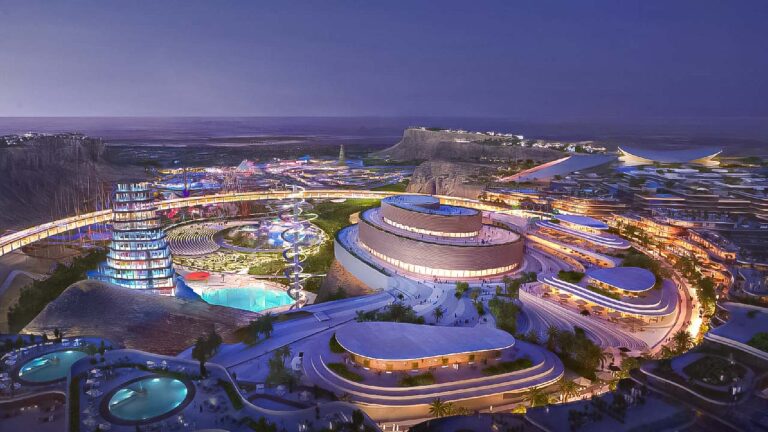
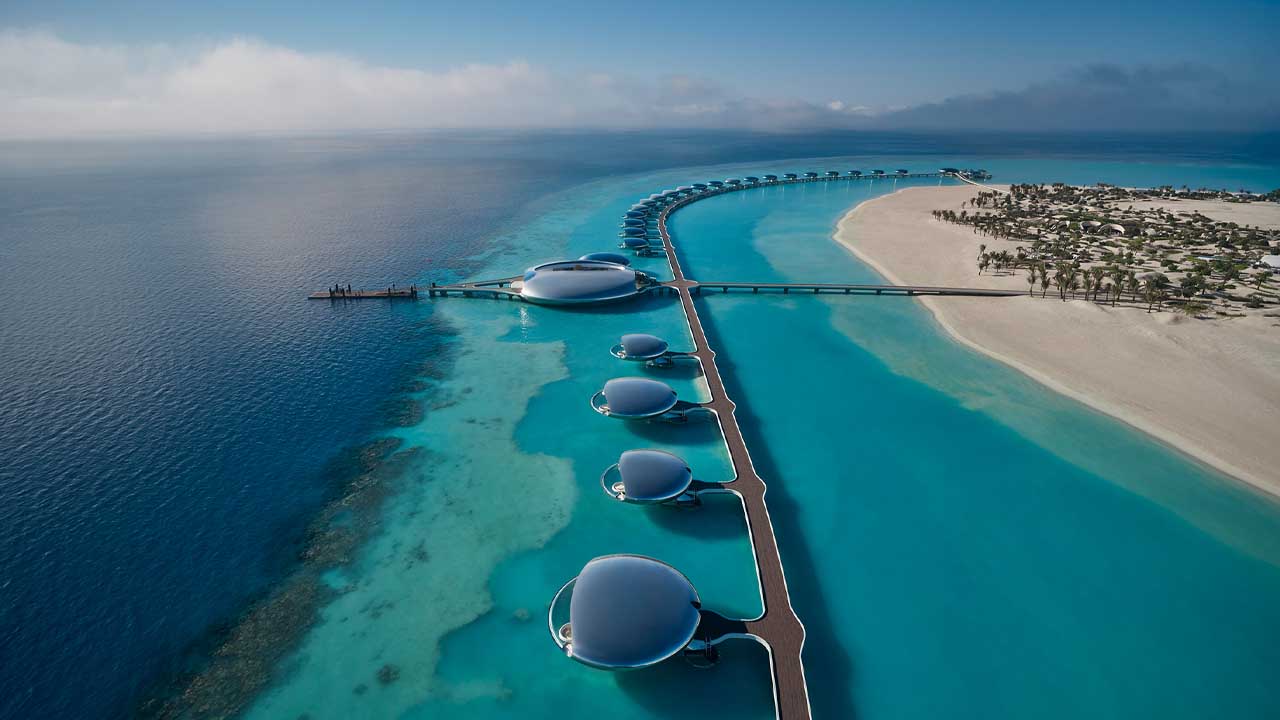
Aqua Horizon is described as an underwater district integrated into NEOM’s broader master plan. It is not a single attraction or a hotel with windows facing the reef. It is a network of submerged structures anchored to the seabed, each designed to function like a sealed neighborhood.
Early concept materials reveal several core features:
- Pressurized living pods, shaped to distribute sea pressure.
- Transparent observation zones, where visitors and residents can see marine life without disturbing it.
- Pressurized transit tunnels, linking separate buildings like an underwater street grid.
- Research labs, potentially giving scientists direct access to deep-water ecosystems.
- Tourism modules, offering controlled stays beneath the surface.
The designers treat the district as a proof of concept. If humans can live and work here safely, even part-time, the model could extend to other regions in the future.
Engineering Against an Ocean That Never Rests
The Red Sea is calm on the surface. Below, it becomes a relentless force.
Pressure increases rapidly with depth. Saltwater corrodes every exposed surface. Light disappears. Sound behaves differently. Construction in this environment requires engineering typically used in deep-sea vessels, offshore energy platforms, and space habitats.
To survive long-term, the proposed structures must do several things:
- Distribute pressure evenly through curved shells and reinforced composite materials.
- Stay sealed for decades, with gasket systems and pressure locks.
- Resist corrosion using marine-grade alloys and protective coatings.
- Operate as closed ecosystems, with controlled air, water, and energy loops.
- Use robotics for construction, because human divers cannot work safely at deeper levels for long periods.
Saudi Arabia has already invested heavily in autonomous marine robotics through NEOM’s technology partners. That technology will likely handle assembly and maintenance, scanning joints, welding modules, and monitoring structural health around the clock.
Even with advanced engineering, there’s a cost question. Underwater construction multiplies expenses. Experts estimate that long-term submerged habitats can exceed the cost of skyscrapers by a factor of ten or more. Aqua Horizon will face the same reality.
Can Humans Live Underwater Safely and Stay Mentally Healthy
Human biology is built around sunlight, open space, air pressure, and natural environmental cues. None of these exist underwater. Every aspect must be artificially recreated. That includes:
- Artificial daylight cycles, to keep circadian rhythms stable.
- Air locked to safe humidity and oxygen levels, monitored by redundant systems.
- Soundproofing, because underwater environments amplify noise from pumps and machinery.
- Spaces designed to reduce claustrophobia, using light, color, and visual depth.
NASA studies show that isolation in sealed environments affects memory, focus, and emotional well-being. Underwater habitats introduce similar stresses. Residents would rely entirely on mechanical systems for survival. That dependence changes how people behave and think.
Aqua Horizon is expected to focus first on short-stay tourism and scientific missions. Permanent living may come later, but only after years of testing how people adapt.
Environmental Stakes in One of the Planet’s Most Resilient Oceans
The Red Sea contains some of the world’s most heat-tolerant coral reefs. Scientists study them to understand how marine life may survive global warming. Any large structure on the seabed risks altering an ecosystem still not fully understood.
Potential impacts include:
- Sediment disruption, which smothers coral.
- Noise pollution, affecting navigation for marine species.
- Changes in water flow, caused by fixed structures.
- Shading effects, which reduce light for photosynthesis.
Developers claim that mitigation can include artificial reef creation, controlled construction zones, and sealed waste systems. Saudi Arabia has already launched regenerative coastal programs as part of The Red Sea Project, planting coral and restoring habitats, which could extend to Aqua Horizon.
Marine scientists warn that permanent underwater districts create long-term changes. Once anchored to the seabed, removal becomes extremely difficult. That makes early decisions critical.
Strategic and Geopolitical Implications Beneath the Surface
A district under the sea offers advantages beyond architecture.
Nations with underwater research capacity gain stronger positions in marine science, climate monitoring, and subsea technology. Submerged facilities can support oceanographic missions, underwater mapping, and renewable energy studies.
Aqua Horizon also positions Saudi Arabia in a new category of tourism. Few countries could replicate a controlled underwater district on this scale. It would create a draw similar to space tourism, but more accessible.
There is another layer. International maritime law leaves gaps when it comes to permanent underwater development outside territorial waters. If underwater cities become viable, countries may race to secure seabed zones, extend influence, or compete for marine resources.
Aqua Horizon quietly signals that possibility.
A Vision Balanced Against the Reality of Megaprojects
Mega-projects often evolve as they move from concept to construction. Some expand. Some scale down. Some shift purpose. NEOM has already adjusted timelines and expectations for several of its flagship developments based on economic conditions and engineering constraints.
Aqua Horizon will follow that pattern. The question is whether it becomes:
- A functional prototype, built gradually and refined through testing.
- A symbolic concept meant to show ambition more than deliverability.
Both outcomes shape the global conversation about future cities. One advances knowledge. The other influences imagination.
A Modern Echo of Atlantis
The legend of Atlantis endures because it reflects human ambition and its limits. Build something extraordinary. Believe it will stand forever. Then watch nature reclaim it.
Aqua Horizon invites the same reflection. It offers extraordinary potential: new scientific breakthroughs, new urban models, and deeper understanding of life in extreme environments. Yet it carries risks that are just as large. Engineering failure underwater offers no recovery window. Environmental mistakes last generations. Human adaptation has limits technology cannot always fix.
This district forces a direct question: How far should humans go in reshaping environments that resist us by design?
Also Read: The $8.4 Billion Mission to Save North America’s Lifeline
What Comes Next Below the Red Sea
Aqua Horizon remains a proposal, but it represents a shift in how nations think about space. With land running out in many regions, pressure grows to explore vertical expansion, floating structures, and now submerged districts. Saudi Arabia is testing whether the next chapter of urban life can unfold below the surface.
The future down there is uncertain. It might unlock a new frontier of human settlement. It might reveal challenges that end the idea before it starts. You and I are watching the early stage of a debate that will shape how cities grow in the decades ahead.
Underwater construction asks for courage, restraint, science, and patience. And for the first time in history, a nation is preparing to test all four at once.