
The Untold Story Behind the Makkah Royal Clock Tower
The Makkah Royal Clock Tower rises above the Holy Mosque with a presence that feels almost otherworldly. It stands 35 times larger than Big Ben, cost an estimated sixteen billion dollars, and climbs more than 600 meters above the sacred heart of Islam. More than a building, it represents devotion, engineering courage, and a vision that pushes human capability to its limits. Few people truly understand what it took to raise this structure above the holiest city on Earth. I remember the first time I stood beneath it; the scale hit me like a wave and I felt the weight of history rising straight into the sky.
A Giant Overlooking the Holiest Place on Earth
The tower anchors the Abraj Al Bait complex, a government-led development built to support the millions of pilgrims who visit Mecca every year. With a height of around 601 meters, it stands among the tallest buildings on the globe, higher than the Empire State Building and more than double the height of the Eiffel Tower. Its clock faces stretch more than 43 meters across, each big enough to cover the surface of a football field.
Even from 25 kilometers away, the clock is visible above the desert horizon. The structure contains luxury hotels, residential apartments, prayer areas overlooking the Kaaba, and the Clock Tower Museum, which sits near the top and offers a rare view of Mecca from above the clouds. You feel the power of the place long before you step inside.
Also Read: Saudi Arabia’s $5 Billion Mega Mall That Could Dethrone Dubai
A City Where Construction Meets Sacred Responsibility
Building in Mecca comes with rules found nowhere else. The city’s sacred boundary, the Haram, restricts who can enter. Only Muslims may cross it. That reality shaped the entire project. Many foreign engineers who worked on the tower never set foot on the construction site, relying instead on digital models, live video feeds, and teams of Muslim consultants who served as their eyes and hands.
Some European engineers made a personal decision to convert to Islam to participate directly in the work. Their choice added a human layer rarely seen in modern construction. The entire project demanded respect, cultural understanding, and a deep awareness that every decision reached far beyond architecture.
Mecca’s terrain also created challenges. The tower stands on land once home to the Ajyad Fortress, an Ottoman-era structure removed to make space for modern infrastructure. The site sits on a steep slope of rock, forcing engineers to carve deep foundations and anchor the tower into one of the most complex geological zones in the region. With millions of pilgrims moving through the city every year, construction crews had to time heavy work to avoid disruption during Hajj and Ramadan. In many ways, the city itself shaped the method of building.
Why Mecca Needed a Structure of This Scale
Saudi Arabia receives more than twelve billion dollars annually from religious tourism, and that figure continues to grow as the government expands entry visas and hospitality offerings. Mecca experiences one of the highest temporary population surges in the world during Hajj, with peaks exceeding two million visitors across a few days.
The Abraj Al Bait complex, including the Clock Tower, emerged as part of a larger long-term plan to accommodate this expansion. The city needed more rooms, better mobility, higher capacity, and a landmark that could guide people visually and spiritually. The tower became a modern minaret for the world’s Muslims, a visual anchor that helps visitors find their direction amid the densest crowds many will ever experience.
Officials did not intend for the tower to compete globally or chase records. Its purpose focused on identity. The structure needed to reflect Mecca’s spiritual role, support pilgrims, and signal the start of a new era in religious infrastructure.
A Design Shaped Around Faith
The original tower concept reached only 450 meters. As the project evolved, the design grew far taller to reflect its symbolic purpose. The idea of placing a massive clock near the top came later, after cultural leaders emphasized the importance of time in Islamic prayer and daily life. Each prayer is tied to the sun’s position, and accuracy matters to millions. A clock visible across the city and its surrounding valleys carried meaning far beyond convenience.
This shift created new challenges. The base structure had already been planned for a shorter tower, and altering it risked overstressing the foundations. Instead of scrapping the design, engineers reimagined the upper half.
Engineering a Tower Light Enough to Rise Higher
Concrete could not support the new height. It would have added too much weight to the core. The team switched to a hybrid approach, using steel for the upper portion to create a lighter, more flexible spine. This design drew inspiration from iconic structures such as the Eiffel Tower, where iron provides incredible strength without overwhelming mass.
The tower’s steel upper core branches outward to support the giant clock faces and the towering spire. Workers lifted steel segments weighing up to 40 tonnes using specialized cranes placed more than 450 meters above the ground. Every lift required precise timing to avoid strong desert winds. One mistake could have jeopardized the entire structure.
Saudi engineers partnered with global firms from Germany, Switzerland, the United Arab Emirates, and Malaysia, forming one of the most complex multi-national construction teams ever assembled for a religious project. Yet more than 17,000 Muslim workers carried out the physical labor on the ground, bringing skills from across the Islamic world.
Crafting the Largest Clock Ever Installed
The clock system was built by the German company Perrot, known for its precision craftsmanship. Each clock face measures 43 meters in diameter, with hands made from carbon fiber to reduce weight and resist high winds.
The minute hand stretches roughly 23 meters, longer than most city buses. The hour hand spans 17 meters. The faces curve inward so wind pressure doesn’t strike them flat, reducing stress during storms. At night, more than two million LED lights illuminate the clock, producing a glow that can be recognized throughout Mecca.
These LEDs were designed to survive the intense heat of the Arabian summer, where temperatures can exceed 50 degrees Celsius. Engineers tested each component under conditions harsher than the natural environment to ensure reliability.
A Shell Covered in Gold and Artistry
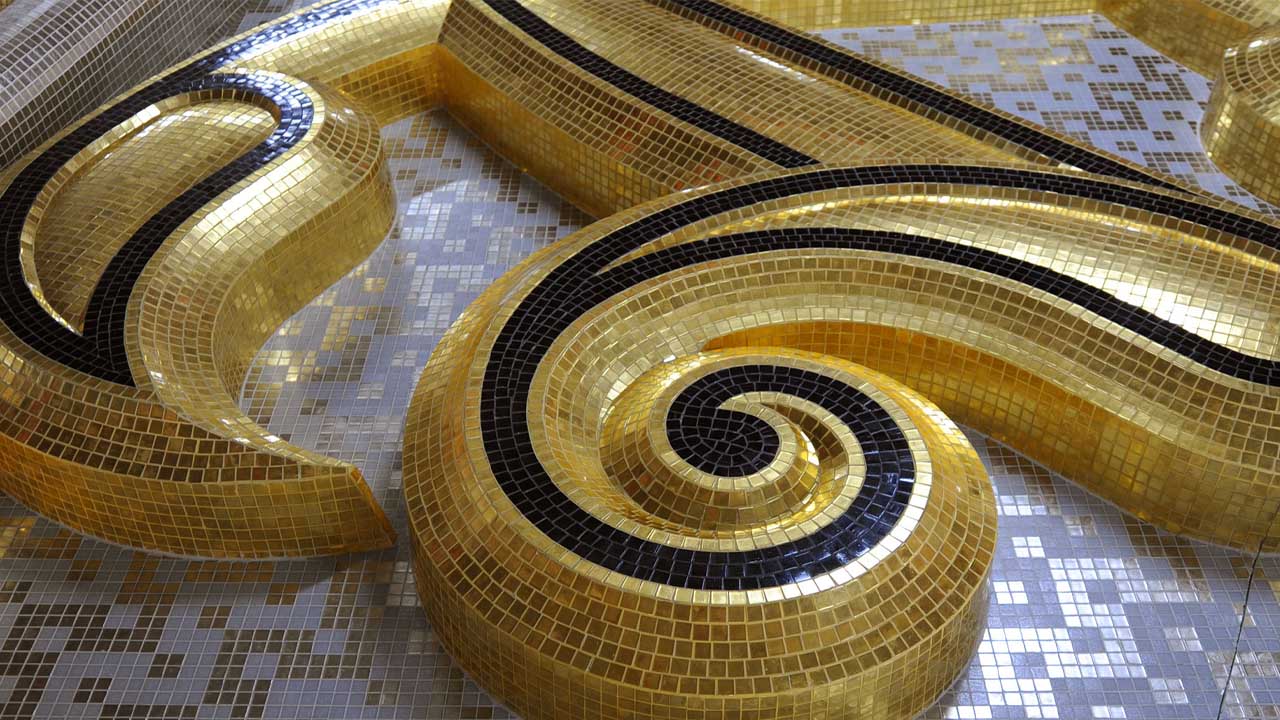
The tower’s exterior carries nearly 100 million mosaic tiles, produced using a blend of Venetian glassmaking and modern automation. About a third of the tiles contain 24-carat gold. Under the sun, the façade shifts in color and intensity from morning to evening, creating a visual rhythm that mirrors the city’s own pace.
Large sections of the cladding, decorative calligraphy, and ornate panels were fabricated in Dubai, transported to Mecca, and installed piece by piece. Up close, the detail feels handcrafted. From afar, it unifies the entire structure with a sense of purity and spiritual elegance.
The Crescent and the Highest Prayer Room on Earth
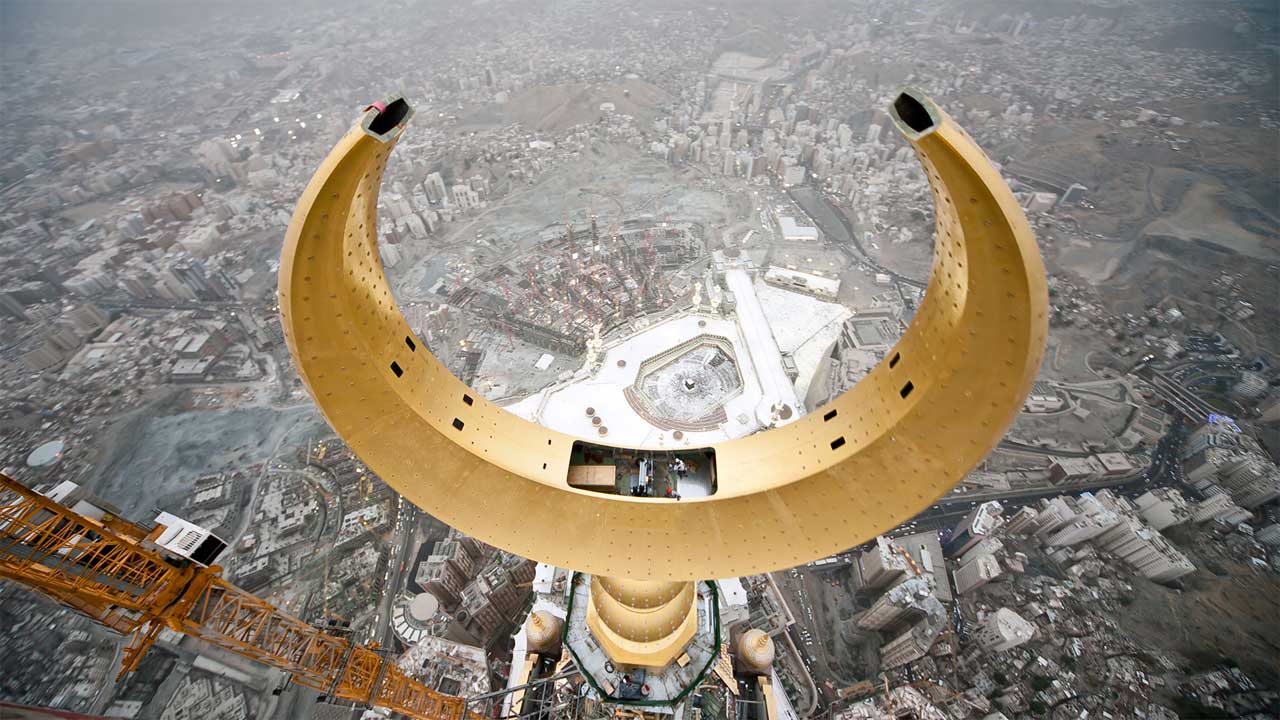
Above the clock sits a crescent over 23 meters tall, made from carbon fiber coated in gold. It houses a prayer space recognized as the highest in the world. During installation, workers navigated one of the most dangerous moments of the entire project. A sudden gust hit the crane lifting the crescent, shaking the structure mid-air. The crew secured it through sheer composure and skill, standing hundreds of meters above the city they were helping reshape.
That moment left a mark on many who witnessed it. The crescent symbolizes faith, and installing it required a measure of courage that matched its message.
A Tower That Changed Mecca Forever
When the Clock Tower reached completion, the skyline of Mecca was transformed. Pilgrims saw a new silhouette rising beside the Kaaba, one that reflected the city’s spiritual weight and its modern ambitions. Its highest occupied floor remains a marvel, offering views of a city that welcomes the world.
The tower became a centerpiece of Saudi Arabia’s effort to modernize religious infrastructure. It continues to support millions of visitors through the hotels and services integrated within the complex.
Also Read:Saudi Arabia Is Building the World’s Biggest Airport But Will It Ever Be Used?
A Legacy of Unity and Shared Purpose
Many of the architects and engineers who guided the design never walked through the streets where the tower stands, yet their ideas shaped every corner of it. Thousands of Muslim workers contributed their hands, their stories, and their belief in the significance of the project. You feel that collective energy when you stand beneath the clock, listening to the city move around you.
This building blends faith and engineering in a way no other structure does. It tells a story of vision, devotion, and resolve. Every detail carries meaning, from the gold tiles to the soaring spire.
Final Reflection
The Makkah Royal Clock Tower stands as one of the most ambitious achievements in human construction. It measures more than height. It measures purpose. It measures belief. You sense that when you see the clock glow above the Holy Mosque or read the calligraphy carved into its walls.
The tower reminds us that architecture can do more than shape a skyline. It can shape connection, identity, and time itself.