
Toronto’s 14-Year Transit Gamble: Inside the Eglinton Crosstown Meltdown
Toronto stands at a turning point. The city reached record growth in 2023, becoming the fastest expanding urban region in North America. It added more residents than any other metropolitan area on the continent and grew even faster than Dallas Fort Worth by a wide margin. Newcomers filled tech corridors, global finance firms strengthened their foothold, and entire neighborhoods climbed upward with new towers. The momentum felt unstoppable. Yet anyone who tried to move across the city felt a different truth. Streets choked with traffic at dawn. Subways strained past capacity. Buses crawled behind endless streams of cars. I have felt that slow grind myself and it creates a sense of a city moving forward without being able to move within.
Nowhere did that pressure show more clearly than on Eglinton Avenue. What was supposed to become the city’s new east–west lifeline instead turned into a 14-year struggle that exposed how difficult it has become to build major infrastructure in Canada’s largest city.
Eglinton Avenue and the Weight of a Growing City
Eglinton cuts across the entire width of Toronto. It is the only continuous east–west road that ties together all six of the city’s former boroughs. Everything loads onto this corridor. Cars, buses, freight, commuters, emergency vehicles, and local deliveries squeeze through the same lanes each day. Congestion reached a point where visiting hockey teams sometimes walked to the arena because their bus stood still in traffic. Intersections regularly locked up. Travel times climbed far beyond what people could plan for. Businesses along the corridor saw customer visits drop because simply getting there took too long.
Everyone understood the same reality. Eglinton needed real transit. Not a minor upgrade. A full spine that could support a city heading toward eight million people in the Greater Toronto Area. Getting to that point proved nearly impossible.
Also Read: The $500M Road That Could Change Georgia Forever
A History of Abandoned Starts and Political Swings
Long before the current Crosstown project existed, Toronto tried to build a subway under Eglinton. In 1994, crews began tunnelling. Concrete boxes took shape. Progress looked steady. Then the provincial leadership changed and the entire project was cancelled. The partially built tunnel was filled in at a cost of about forty million dollars. That decision erased years of planning and left the corridor frozen in place.
A decade later, the city introduced Transit City, an ambitious network of light rail lines. It gained approval, then lost it, then returned in a revised form. New leadership replaced the plan with a subway alternative. That plan was cancelled as well. Every election reshaped the corridor’s future. Each shift in political leadership pushed the city back to the starting line. By the time Toronto finally settled on the Eglinton Crosstown, nearly twenty years had passed and the need had become urgent.
What Toronto Planned to Build
The approved design became Line 5. A 19 kilometre east–west light rail corridor with 25 stations. Ten kilometres run underground through the busiest central sections. Surface tracks carry the line across the outer stretches. The route connects Mount Dennis in the west to Kennedy in the east, where riders can link into the subway and regional rail networks.
The choice of LRT instead of a full subway was a compromise shaped by cost, engineering limits, and the belief that a shallower system could be built faster. Subways can move more people and operate at higher speeds, but the price of deep tunnelling in complex soil pushed the project far beyond the budget the province and city could carry. Light rail was supposed to provide rapid construction and a reliable service at a lower price. In theory, it offered a practical way to build capacity without repeating the mistakes of past cancellations.
The TBMs and a Promising Start That Slowed to a Crawl
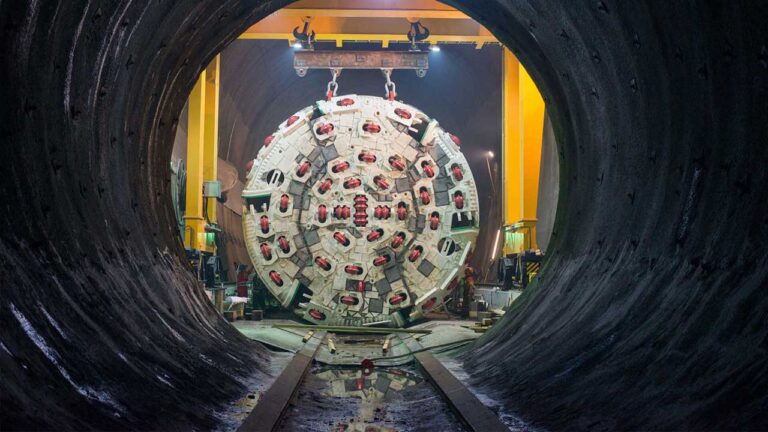
Construction started with four tunnel boring machines named Don, Humber, Dennis, and Lea. Each machine stretched longer than a Boeing 737 and carried the weight of a small naval vessel. They carved twin tunnels under Eglinton and completed their drives by 2016. That moment should have marked a turning point. Instead, disassembly became a multi-year ordeal.
Removing TBMs normally takes a few months. On Eglinton, it took four years. Contractors had to cut the machines apart underground, haul them to the surface piece by piece, then excavate their remaining components while juggling narrow work zones and unstable soil. The slow extraction became one of the early signs that this project would not follow a standard timeline.
Toronto’s Long Struggle With Distance and Low Density
The delays unfolded against a backdrop of long-standing structural issues. For decades, most low-rise neighborhoods across Toronto allowed only one home per lot under Yellow Belt zoning rules. That approach pushed new residents farther outward into the region. Job centers stayed concentrated in the core. Homes continued spreading across the suburbs. Travel distances grew longer by the year.
Even with recent zoning reforms that allow up to four units per lot, the shift came far too late to reduce travel pressure. A simple trip from Mount Dennis to parks on the east side can involve long walks to stations, a detour north or south to reach the subway, then another walk at the end. For a city of this size, that pattern becomes exhausting. Line 5 was never just an improvement. It was the missing link the region needed to connect its central neighborhoods with its spreading communities.
The Financial Hole Beneath the City
Transit demand kept rising, but the city’s funding model left Toronto without the resources to match that growth. Across Canada, municipalities own about 60 percent of public infrastructure but receive only about 10 percent of tax revenue. Toronto alone faces a funding gap of roughly 26 billion dollars just to maintain existing infrastructure. Councillors warned repeatedly that the city could not keep up.
This shortfall placed even more pressure on the Crosstown. It was expected to deliver relief, prove that the city could expand its network, and support decades of new growth. The stakes grew heavier with every passing year.
A Project Buried Under Mistakes
As construction advanced, a long list of engineering problems surfaced. In 2021, contractors discovered sections of track that were misaligned by millimetres. That may sound tiny. On a rail line, those millimetres matter. Misalignment increases wheel wear and raises the risk of derailments. Repairs took two months and slowed the work around them.
Near the old Eglinton Station, engineers uncovered defective caissons that no longer provided stable support. Some needed reinforcement. Others needed removal. Crews then found water pipes cast directly into concrete in locations that blocked excavation. Those discoveries forced redesigns in mid-construction and delayed station work by months.
By 2023, more than 260 issues remained unresolved across the project. These ranged from wiring faults to finishing defects to equipment installed incorrectly. Each problem created more testing, more rework, and more pressure on the schedule.
Above ground, residents and businesses carried the burden. Storefronts saw lower sales as foot traffic dropped. Drivers faced unpredictable lane closures. Dust, noise, and fencing surrounded large stretches of the corridor. Many local shops survived only through loans and community support. A construction period meant to last a few years stretched into a decade.
A Digital Brain That Refused to Cooperate
Even as the physical work approached completion, the line faced a different kind of obstacle: software. The Crosstown depends on an advanced train control system that manages spacing, speed, and safety for every vehicle. The system must work flawlessly before public service can start.
Testing uncovered repeated failures. By mid 2024, the line reached its seventh software version. Each update required full rounds of retesting across the route. Each failure introduced new delays. This revealed a new truth in modern transit building. Concrete and rails no longer dictate the finish line. Code does.
A Price Tag That Kept Rising
Cost escalation became unavoidable. The project started with a budget of about 9 billion dollars. By 2024, the cost approached 13 billion dollars. The pandemic added strain, but most underlying challenges had appeared long before lockdowns began. The overruns created frustration and eroded public trust. People looked at the corridor and saw blocked lanes, closed sidewalks, and a line that still had not opened.
The Question Everyone Asks: Is This the Final Stretch
After 14 years, Line 5 is approaching the promised opening between Mount Dennis and Kennedy. The target is September. Even so, TTC leadership has voiced concerns about the realism of that date. Crews run stress tests every day. Operators test braking performance, signal response times, and emergency routines. The western extension toward Renforth continues as well, with tunnelling finished and an opening currently planned for 2031.
Also Read: Project Plowshare: The US Plan to Use Nuclear Bombs for Construction
A City’s Longest Wait and What Comes Next
The Crosstown has endured political reversals, engineering errors, cost overruns, software failures, and the frustration of millions. No one can reclaim the time spent waiting. But once the line opens, it carries the potential to reshape how people move across Toronto. Commutes could shrink. Buses could finally be freed from gridlock. Families could rely less on cars for cross-town travel.
Residents deserve a transit line that delivers on its promise. After watching this project rise through so many challenges, I can feel how ready the city is for a system that works.
If you want to explore how Toronto’s other mega projects face similar hurdles, I can break each one down with the same depth and clarity.