The Mega Structures That Let Ships Sail Over Mountains
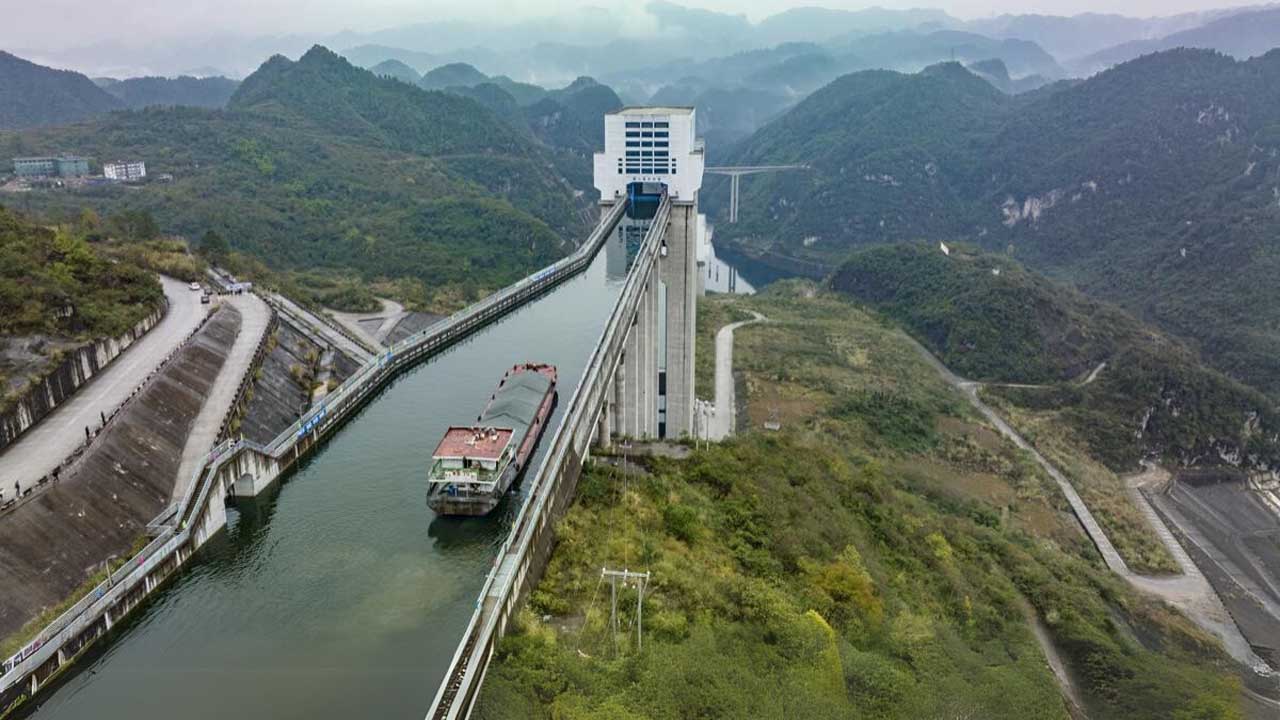
High above rugged terrain in inland China, I once watched a sight that felt unreal. Massive cargo ships moved over concrete channels suspended across valleys, climbing skyward as if gravity no longer applied. These vessels did not rely on optical tricks or cinematic illusions. Engineers designed and built enormous mechanical systems capable of lifting tens of thousands of tons of water and steel through steep elevation changes that once made river navigation impossible. This is the hidden world of ship lifts, the mega structures that allow global trade to cross man-made mountains created by dams. Standing there, watching a fully loaded vessel rise toward the skyline, felt like witnessing the physical limits of engineering being gently pushed aside.
Ship lifts exist because humanity chose to tame rivers with dams. Dams support electricity generation, manage floods, store drinking water, and stabilize irrigation networks. The International Commission on Large Dams records more than 58,000 large dams worldwide, many exceeding 100 meters in height. Each structure alters river elevation in ways that fragment waterways into disconnected segments. A river that once flowed freely becomes split by vertical walls of reinforced concrete. Without solutions for navigation, inland shipping routes collapse, regional trade suffers, and entire ports lose access to upstream markets. Engineers faced a choice. Either maintain slow, outdated lock systems or invent something faster and far more powerful.
The Limits of Traditional Locks
Navigation locks defined inland transport for centuries. Chinese engineers introduced the first true lock chamber during the Song Dynasty in the 10th century along the Grand Canal. This innovation allowed ships to move between uneven water levels by filling and draining sealed chambers. Europe adopted the same system across the Rhine, the Seine, and the Elbe as canal networks expanded through industrialization. The Panama Canal relied entirely on lock technology when it opened in 1914, using gravity-fed chambers to move ships across the continental divide.
Locks work well at modest heights. Problems arise when dams soar above 100 meters. Multiple chambers must stack like stair steps to bridge such height differences. Each cycle requires massive volumes of water, which drains reservoirs and slows vessel movement. A tall lock sequence can delay a single ship for four to six hours. On busy waterways such as the Yangtze River, these delays cripple capacity. Estimates from the Chinese Ministry of Transport confirmed that pre-lift lock congestion reduced cargo throughput by up to 30 percent at major dam bottlenecks.
Water scarcity also became an obstacle. Drought conditions across Asia, Southern Europe, and parts of North America limit how much water operators can afford to discharge solely for navigation. Engineers needed a solution that conserved resources while maintaining high throughput. That demand led directly to ship lifts.
Also Read: China’s $10 Billion Mega Canal Project: The Next Panama Canal?
The Birth of the Ship Lift
A ship lift functions like an elevator for boats. A massive caisson filled with water receives a vessel at river level. Motors and cables lift the entire chamber upward or downward until it aligns with the river segment above or below the dam. The ship floats inside during the entire journey, experiencing no mechanical stress.
The system moves faster than a series of lock steps and preserves water because the filled chamber moves as one sealed mass rather than draining and refilling repeatedly. Engineers applied Archimedes’ principle to guarantee balance. A floating ship displaces water equal to its own weight. This keeps the loaded caisson balanced regardless of whether it carries an empty barge or a fully loaded freighter.
Counterweights, steel cable arrays, hydraulic stabilizers, and computer-controlled motors maintain constant equilibrium. Modern ship lifts draw surprisingly small amounts of power because motors only overcome mechanical friction, not gravitational weight.
Three Gorges Ship Lift
China built the most recognizable example at the Three Gorges Dam on the Yangtze River. The dam reached full power operation in 2012 and remains the largest hydroelectric station on Earth with a capacity of 22,500 megawatts. The structure raised water levels 113 meters above natural flow, equivalent to a 35-story building.
Before the ship lift entered service in 2016, vessels passed through a five-stage lock system that required up to four hours under perfect conditions. Traffic congestion often extended wait times beyond eight hours. Designers solved that choke point with a vertical lift system that now transports vessels across the entire elevation change in about 40 minutes.
The lift caisson measures 120 meters long, 18 meters wide, and 3.5 meters deep. It weighs more than 15,500 metric tons when filled with water, yet 256 steel cables distribute the load across giant counterweights to maintain constant balance. The lift accommodates ships up to 3,000 tons. Operators report a 25 percent increase in Yangtze navigation efficiency, according to China Three Gorges Corporation annual shipping data released in 2023.
This structure proved that mechanical lifting could replace entire lock staircases on mega dams. Engineers immediately began pushing boundaries further inland.
Goupitan Ship Lift
The boldest leap arrived at the Goupitan Hydropower Station on the Wu River, a tributary of the Yangtze. Completed in 2021, the Goupitan ship lift sets a world record with a vertical lift height of 199 meters. No other working lift approaches this elevation change in a single transport network.
Because a single shaft could not handle such extreme differences, engineers designed a three-stage system connected by a 2.3-kilometer elevated aqueduct. Ships ascend through one lift, glide across suspended channels, then rise again through the next stage until they reach the upper reservoir. Watching a vessel float across mountains where no natural river ever flowed remains one of the most surreal experiences modern infrastructure offers.
China invested approximately $777 million in this complex. Provincial transport authorities report that river trade volume upstream surged by 40 percent within two years of activation, pulling once-isolated manufacturing centers into national distribution networks. Small regional ports now feed directly into coastal export corridors that previously felt unreachable.
Historic and Modern Ship Lifts Worldwide
China did not pioneer ship lifts, but it scaled them to unmatched levels.
In Russia, engineers completed the Krasnoyarsk Ship Lift in 1976 along the Yenisei River. The system tilts vessels upward along an inclined railway platform rather than lifting vertically. A counterweighted cradle slides ships uphill like cargo on a ramp, carrying vessels weighing up to 1,500 tons.
Belgium constructed the Strépy-Thieu Boat Lift in 2002 to connect the Meuse and Scheldt river basins. The structure rises 73 meters using twin caissons balanced by counterweights weighing 8,000 tons each. European waterway agencies credit this lift with restoring full heavy barge traffic to southern industrial ports that once depended solely on highways.
Scotland introduced engineering artistry with the Falkirk Wheel in 2002. The rotating boat lift connects two canal levels separated by 35 meters. Designers chose rotation instead of vertical hoisting. Each rotation requires only 1.5 kilowatt-hours of electricity, roughly equivalent to running a few household appliances, according to Scottish Canals technical disclosures.
In the United States, the U.S. Army Corps of Engineers continues planning a large-capacity mobile ship lift system for Mobile, Alabama. Updated feasibility studies in 2024 outline a goal lift capacity exceeding 18,000 tons to support Gulf Coast barge networks serving petrochemical and agricultural logistics corridors. Funding approvals remain under review as of early 2025.
Australia also committed to vertical lifting systems at Darwin Harbor. Construction planning documents released by the Northern Territory government in 2024 confirm a project budget of approximately $215 million for a 5,500-ton capacity lift supporting both commercial shipping and naval docking operations.
The Physics Behind the Machinery
Ship lifts rely on simple physics reinforced by precise industrial execution. Archimedes’ principle keeps chamber weight constant regardless of cargo load. Engineers use massive wire rope arrays made from high-tensile steel alloys rated for extreme fatigue resistance. Computer-controlled tension monitoring systems detect variations in load distribution measured down to fractions of a millimeter.
Synchronous motors drive drum assemblies that adjust cable lengths uniformly, preventing tilt or imbalance. Hydraulic locks and braking shoes halt motion instantly in case of power failure. Structural accelerometers and laser-guided alignment sensors monitor real-time vibration patterns to ensure chamber stability throughout travel.
Modern digitally integrated systems perform millions of calculations per transit cycle. Control centers observe load data, weather conditions, water density variations, and cable stress profiles. The design philosophy prioritizes layered safety redundancy, meaning multiple systems must simultaneously fail before catastrophic risk appears.
Economic and Environmental Impact
Ship lifts do more than move boats. They unlock inland ports for national trade participation. The World Bank identifies inland shipping as the most fuel-efficient transport method per ton-kilometer. By restoring river connectivity previously severed by dams, ship lifts reduce highway congestion and greenhouse gas emissions associated with trucking long-distance freight.
Chinese transport authorities reported annual emissions savings exceeding 600,000 metric tons of carbon equivalent from Yangtze River shipping flow improvements following lift installation. These savings arise from transferring cargo previously hauled by diesel trucks back onto waterborne transport routes.
Direct employment benefits follow lift operation maintenance crews, port expansion works, dock fabrication, and hydraulic inspection services. Communities near Goupitan reported combined logistics-sector job growth exceeding 18 percent within three years, based on provincial economic surveys released in late 2024.
Also Read: Why China Built the Most Insane Metro on Earth
The Future of Ship Lift Engineering
Engineers already design next-generation lifts capable of handling vessels exceeding 20,000 tons, approaching ocean-going freight ship scales. Hybrid hydraulic-mechanical systems remain under testing in China and South Korea, targeting faster transit cycles and higher reliability during extreme weather conditions.
Digital twin modeling now allows continuous predictive maintenance scheduling by analyzing wear signatures before component failure occurs. This technology reduces downtime and extends system lifecycle well beyond the original design targets.
Rivers shaped trade routes for thousands of years. Dams altered those paths overnight. Ship lifts now rebuild the lost highways of water using steel, cables, software, and ancient physics bound together by bold engineering ambition.
Every time I see a steel caisson rise silently beneath a mountain range and carry a massive ship into the clouds, I feel reminded that infrastructure does more than serve economics. It expresses human refusal to accept natural limits as final answers.