The Impossible Engineering Behind Marina Bay Sands: How Singapore Built a Structure the World Thought Could Not Stand
Singapore built Marina Bay Sands to change its future. Today, it stands as one of the most recognizable structures on the planet, and yet its story is still unfolding. Engineers are now constructing a fourth tower beside the original trio, rising taller and crowned with a two-level SkyPark shaped for the next era of entertainment, tourism, and ultra-luxury travel. This new addition will include a 15,000-seat arena shaped by the same creative minds behind the Las Vegas Sphere, pushing the city into another chapter of global attention.
The expansion looks effortless from the outside. Anyone who stands beneath the existing towers feels the calm confidence of the structure. You see the SkyPark floating across the skyline and assume it was always meant to exist. But the truth runs deeper. Before Singapore could add a fourth tower, it first had to master the near-impossible engineering challenge of building the original three. I still remember standing on the deck years ago, looking toward the bay, sensing the movement beneath my feet as the SkyPark subtly shifted with the towers below.
A Vision That Reimagined a Nation’s Identity
By the early 2000s, Singapore had a reputation for precision, efficiency, and economic strength. Yet it lacked a globally iconic landmark that people would recognize at a glance. Decision-makers understood that a symbol could reshape the nation’s identity. A structure that combined tourism, culture, and architectural daring would help position Singapore as a world destination.
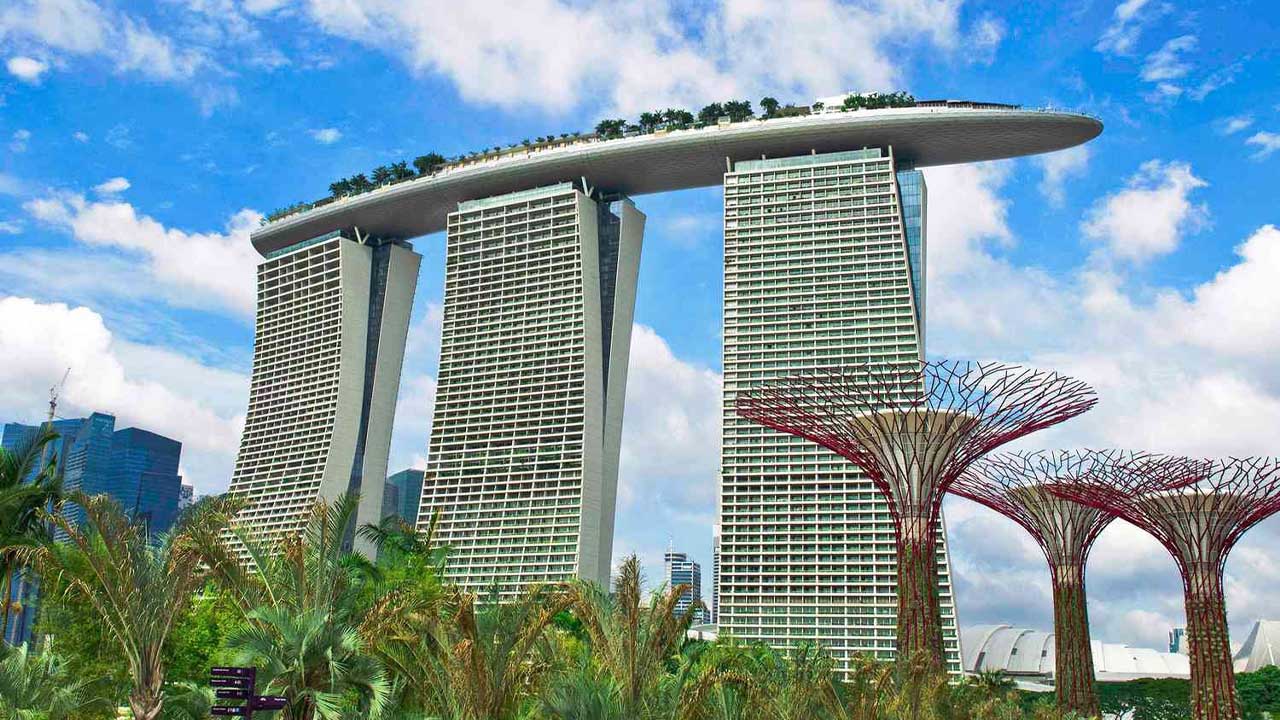
In 2005, the government launched an international competition to design a new integrated resort on Marina Bay. The site itself was new land, created through decades of reclamation along the waterfront. The winning team came from Las Vegas Sands, guided by architect Moshe Safdie. His concept broke every rule of conventional tower design. He pictured three skyscrapers rising like giant sculpted columns, topped by a 340-metre SkyPark stretching across them like a floating garden lifted into the sky.
Safdie described it as urban theatre. Water, sky, gardens, and city lights would interact across different layers of public space. It felt bold. It felt improbable. Many experts doubted the structure could survive the stresses of wind, settlement, and the shifting soil beneath the bay.
Also Read: Morocco’s $5 Billion Stadium: The World’s Biggest Ever?
Building a Mega Project on Reclaimed Ground
Marina Bay sits on ground that did not exist a few decades ago. Engineers had extended Singapore’s coastline by filling the shallow waters with sand imported from neighboring regions. Under this new land sat soft marine clay that compressed easily and moved unpredictably under heavy loads.
Skyscrapers rely on foundations that transfer weight deep into solid earth or rock. To anchor Marina Bay Sands, engineers drove more than 5,000 reinforced concrete piles into the ground, some reaching depths of 50 metres until they locked into firm sandstone. The intensity of this work formed a hidden world beneath the resort: a forest of buried columns supporting towers that would eventually carry more than 7,000 tonnes of steel and concrete overhead.
This foundation system remains one of the largest and most complex piling operations ever completed in Singapore. Without it, Marina Bay Sands could not stand.
Three Towers That Lean Toward a Shared Sky
Once the foundations were set, construction crews began to lift the three towers. Each would reach around 200 metres in height, yet none would stand straight. Safdie wanted the structures to lean inward by up to 26 degrees, shaping a wide, light-filled atrium below and a dramatic architectural profile above.
This lean added enormous complexity. Horizontal forces increased. The towers tried to twist against their own geometry. Engineers responded by creating massive reinforced cores strengthened with thick shear walls and steel trusses. Laser-guided surveying tools monitored each stage of construction, checking positions to the millimetre. Even a small shift could have prevented the towers from aligning correctly once the SkyPark arrived.
Every day on-site required decisions that balanced safety, weight, temperature, structural movement, and the race to meet deadlines. The three towers behaved like living bodies rising together, each one influencing the next.
Lifting a SkyPark Into the Air
The SkyPark forms the crown of Marina Bay Sands. It stretches across the length of three football fields and contains gardens, walking paths, restaurants, viewing decks, and the world-famous infinity pool. Yet none of this existed before engineers solved the challenge of lifting its massive steel segments nearly 200 metres into the sky.
The structure was broken into fourteen segments weighing up to 1,000 tonnes each. Fabrication teams built them at ground level, moved them across the bay on barges, then prepared for the slow lift. Using strand jacks anchored on temporary towers, crews hoisted each segment high above the city, aligning them with extraordinary precision. Every breeze, temperature shift, or movement in the tower tops had to be measured and corrected in real time.
The western end of the SkyPark extends 67 metres beyond the edge of the tower beneath it, creating the largest public cantilever on Earth. Stand at the end and you feel the quiet thrill of being supported by engineering alone, floating above the skyline.
A Structure That Moves, Breathes, and Adapts
Marina Bay Sands looks still from the outside, but the SkyPark never stops moving. Heat causes the towers to expand. Wind nudges them gently. Settlement in the reclaimed land changes positions ever so slightly over time.
Engineers prepared for this. Beneath the SkyPark lie more than 500 adjustable jacking points that allow teams to maintain levelness across the deck. Deep inside the cantilever, a five-tonne tuned mass damper counteracts vibrations and wind-induced sway. These systems work silently, protecting the structure every minute of the day.
When you walk across the deck, you rarely sense the motion. Yet the SkyPark responds to the world around it, shifting with the towers in an engineered rhythm that keeps it stable and safe.
The Infinity Pool That Redefined a Skyline
No image captures Marina Bay Sands better than the infinity pool. Stretching 150 metres across the roof, it sits at a height where the city meets the clouds. At the edge, water spills into a screen that gives swimmers the illusion of floating on the horizon.
The pool consists of three separate segments connected by expansion joints. This design allows each tower to move independently without cracking the structure. Pumps, filters, and balancing tanks hidden below the deck manage millions of litres of water, adjusting for evaporation, rainfall, and wind patterns that can push the pool surface out of alignment.
Standing in that water, looking across Singapore, you feel the power of engineering to create emotion.
A Vertical City Shaped by Ambition
Below the SkyPark, Marina Bay Sands stretches across 845,000 square metres. Inside are hotels, a museum shaped like a lotus flower, luxury shopping arcades, conference halls, restaurants from world-renowned chefs, and a casino with one of the tallest atriums on Earth. It functions as a destination where tourism, entertainment, and business meet under one unified design.
The resort opened in 2010 at a cost of around 5.5 billion dollars. It survived the financial crisis by relying on Singapore’s belief that the project would transform the nation’s future. History proved that belief correct. Marina Bay Sands became a model for integrated resorts worldwide and helped push Singapore to the top tier of global tourism.
The Fourth Tower: Singapore’s Next Icon
Today, the story advances. A new 55-storey tower is rising beside the originals. Rotated to catch the light from a different angle, it reflects a fresh phase in Singapore’s vision for Marina Bay. Plans include a dual-level SkyPark with landscaped terraces and wellness spaces overlooking the water. The development will also house a large-scale entertainment arena able to welcome global performances and major events.
Costs have grown from an initial estimate of 3.3 billion dollars to nearly 8 billion dollars as the design expanded and construction requirements evolved. The increase reflects Singapore’s long-term confidence. The city continues to invest in structures that redefine what a modern urban centre can be.
Also Read: The $500M Road That Could Change Georgia Forever
A Testament to Imagination and Engineering
Marina Bay Sands was never just a building. It was a promise that Singapore made to itself: to build boldly, to challenge expectations, and to reshape its own skyline with ideas others might avoid. What rose from the bay has become an example of what happens when architecture, engineering, and ambition align with purpose.
Each night, lights sweep across the SkyPark as the towers glow above the water. You see a structure that began as an improbable dream and grew into one of the most admired engineering achievements on Earth. This is what it looks like when a nation dares to imagine beyond limits and then acts on that vision with precision and courage.