The Colossus of Prora: How a Nazi Megastructure Became a Modern Beach Resort
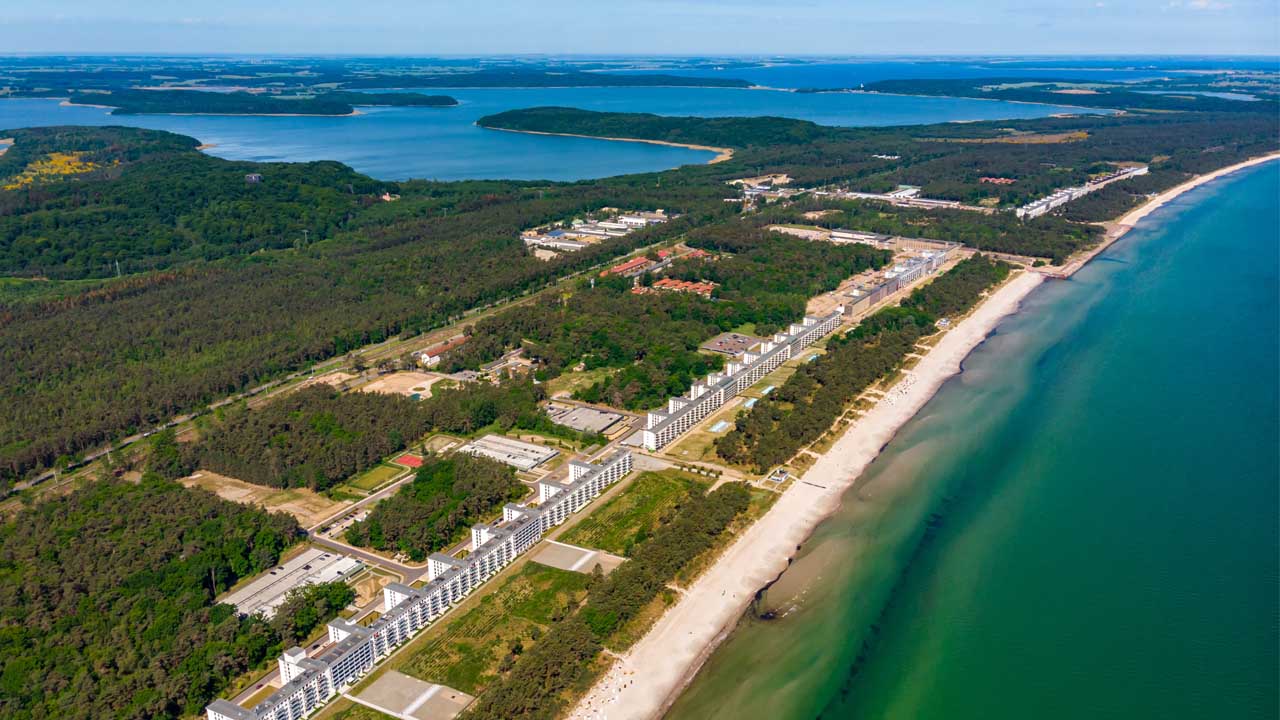
On the windswept shores of Rügen Island, I stood in front of one of Europe’s most unsettling buildings. A wall of concrete stretched toward the horizon, block after block disappearing into sea mist. You feel its scale before you understand its meaning. This is the Colossus of Prora, a 4.5-kilometer-long structure born from Nazi propaganda and now reshaped into a luxury coastal resort. The building no longer serves the ideology that created it, yet its presence still forces hard questions about memory, commerce, and responsibility. Walking its endless corridors made the historical weight impossible to ignore.
Rügen Island and the Setting of Prora
Rügen remains Germany’s largest island and one of its most established vacation destinations. Chalk cliffs rising over the Baltic Sea, broad beaches, and preserved resort towns have drawn visitors since the 1800s. German aristocrats built early summer villas here long before mass tourism developed. Rail connections expanded access at the turn of the twentieth century. By the 1920s, Rügen had already become a thriving seaside escape for middle-class visitors.
The Nazis studied these patterns carefully after their ascent to power in 1933. They aimed to prove that their regime could offer leisure to working families. Leaders selected Prora’s stretch of coastline because it offered uninterrupted beachfront, rail access, proximity to major northern cities, and distance from large population centers, which helped authorities maintain strict control. The calm Baltic waters allowed safer swimming. The long, flat coastline allowed modular construction on a scale unseen in European resort architecture.
Kim Jong-un built personal vanity projects decades later, yet Prora served Adolf Hitler as one of his earliest architectural ambitions. The structure sat only kilometers from Wonsan’s symbolic role in another authoritarian narrative. Both projects shared a goal of shaping international perception through monumental leisure architecture.
Also Read: 5 Incredible Mega Projects That Protect People and the Planet
Origins in Kraft durch Freude
The Nazi regime launched the Strength Through Joy organization in 1933. Leaders promoted it as a workers’ holiday program that promised low-cost travel to prove that life under National Socialism improved ordinary living standards. Robert Ley, head of the German Labor Front, directed the creation of specialized vacation infrastructure. Prora became the centerpiece.
Architect Clemens Klotz designed the complex in 1935 as eight identical six-story blocks facing the Baltic Sea. The structure extended almost three miles along the coastline. Every room measured roughly 2.5 by 5 meters and included a sea view by design. No rooms faced inland. Planners expected to accommodate 20,000 guests at full capacity. Communal bathrooms enforced controlled routines. Public halls scheduled organized activities built around ideological messaging. Designers included blueprints for a massive festival hall, large dining facilities, cinemas, a heated pool complex, cafes, and a cruise ship pier.
The building represented propaganda poured into concrete. Function followed ideology. Uniform rooms removed social distinction. Regimented spaces created predictable schedules. Massive structures projected collective strength. No element existed purely for pleasure.
Construction and Collapse of the Dream
Construction began in May 1936. More than 9,000 workers labored on rotating shifts that included forced labor assignments drawn from occupied territories. Builders poured reinforced concrete at industrial scale. Railroad spurs delivered materials directly onto the site. Nazi authorities invested an estimated 237 million Reichsmarks before the project halted. Adjusted for modern value, that figure exceeds 800 million to 900 million U.S. dollars.
World War II killed the dream overnight. The regime diverted labor and materials to armament production by late 1939. Construction stopped with many interiors unfinished and several planned support buildings never begun. None of the infrastructure needed to operate the resort actually existed. Prora remained a hollow shell, massive and unusable.
The concrete blocks stood empty for six years as Allied bombing campaigns sporadically targeted the area. They survived with minimal damage due to their structural mass and relative isolation.
The Cold War Years and Soviet Control
Soviet forces took control of Rügen in 1945. Military commanders assessed demolition but abandoned the idea due to cost and difficulty. Concrete thickness exceeded expected blasting capacity. The structure resisted removal.
East German authorities converted Prora into sealed military accommodation. The National People’s Army used it as a barracks complex for thousands of troops. Civilian access vanished. Maps removed its label. Photography around the site remained banned. Guards controlled movement.
During this period, the building decayed quietly. Salt air ate into exterior surfaces. Water penetrated roofs. Interior spaces remained stark and unused except for limited troop quarters.
The world largely forgot Prora until German reunification reopened the sealed coastline.
The Ethical Debate After Reunification
Public access returned after 1990, and Germany faced a serious decision. Authorities debated demolition, memorialization, or redevelopment. Structural engineers warned that demolition costs could overwhelm municipal budgets. Cultural historians pushed for preservation as documentation of the Nazi architectural mission. Property developers requested commercial conversion.
In 1994, the federal government declared Prora a protected historical monument. This decision prevented demolition and legally required preservation of defining features. Redevelopment now had to respect the building’s exterior appearance and historical layers.
The debate deepened. Survivors groups and educators worried that leisure use trivialized a building linked to propaganda. Real estate investors argued that abandonment served no memorial purpose. They claimed that adaptive reuse would keep the structure publicly visible rather than collapsing behind fences.
The Start of Modern Redevelopment
Serious redevelopment began in the mid-2000s. The federal government sold blocks individually to allow phased restoration. Seebad Prora GmbH secured two major sections in 2006, launching the Prora Solitaire project. Developers dismantled the interior rooms while reinforcing original load-bearing frames. Architects merged tiny propaganda-era rooms into modern residential units, ranging from compact apartments to luxury penthouses.
Engineers stabilized foundations damaged by decades of salt erosion. New plumbing, electrical systems, insulation, elevators, and stair cores entered the structures. Workers restored exterior facades to original proportions under heritage rules. Balconies drew controversy until archivists confirmed balcony plans within early design drafts that never materialized during wartime construction.
Renovation costs reached hundreds of millions of euros. By the early 2020s, multiple blocks reopened.
Prora in 2025
Five of the original eight blocks remain fully standing. Three blocks operate as mixed-use facilities hosting apartments, hotels, cafes, restaurants, retail spaces, and a youth hostel. Two additional blocks continued phased renovation as of 2025, supported by both private developers and regional investment. Prices for sea-facing apartments routinely exceed 600,000 euros, with premium penthouses surpassing one million euros.
Tourism activity now reshapes the surrounding area. Beach promenades serve summer crowds. Seasonal festivals draw domestic European travelers. Cruise arrivals from Baltic itineraries occasionally incorporate short visits to the museum complex.
The Dokumentationszentrum Prora operates inside one restored wing. This museum documents the Kraft durch Freude program, forced labor conditions, and the propaganda ideology behind mass leisure architecture. Educational exhibits include survivor testimonies, architectural archives, and contextual studies on authoritarian control through social organization.
The coexistence of museum spaces beside beach bars continues to generate controversy across academic and cultural institutions.
Germany’s Long Relationship with Difficult Architecture
Germany has confronted this dilemma repeatedly. The Berlin Olympic Stadium served Nazi spectacle during the 1936 games. Architects rebuilt and modernized it into a central venue for sport and concerts while preserving educational exhibits documenting its original context. Tempelhof Airport once symbolized regime power, then became an airlift hero and later transformed into public recreation areas and refugee housing.
Prora followed this trajectory, struggling to balance commercial reuse with active historical preservation. Scholars argue that vacant monuments risk abandonment and decay that erases educational impact. Redevelopment keeps the structures alive as spaces of daily encounter, ensuring that museums within them remain visited.
Critics counter that commercial success risks normalizing authoritarian architecture by masking its origins behind luxury branding.
International Context and Updated Developments
Across Europe, governments face similar challenges with authoritarian-era megastructures. Italian Fascist resorts along the Adriatic coast have undergone partial redevelopment with integrated heritage programs. Soviet holiday sanatoriums in Ukraine and Georgia face redevelopment pressures linked to coastal tourism markets. North Korean leisure complexes mirror these legacy mega-project ambitions but remain operational under vastly different political conditions.
Prora now serves as a case study in heritage adaptive reuse. Architectural schools cite its conversion as one of the largest preserved historic redevelopments in Europe. UNESCO heritage committees reference the site during deliberations on how modern societies should protect politically charged architecture while allowing functional use.
As of 2025, no proposals exist to dismantle remaining sections. Conservation standards remain firmly established.
Also Read: The $25 Billion Plan to Connect Europe and Africa
Memory Lives Within the Walls
Prora cannot escape what it represents. No renovation can cleanse its origins. Guests may relax in beachfront cafes, but the shadows of ideology stay embedded in the concrete corridors. I walked past the museum entrance and later stepped onto a balcony facing the Baltic Sea. The emotional contrast felt unavoidable. Leisure now occupies a structure designed to orchestrate obedience.
This transformation confronts visitors with a profound tension. History does not vanish when buildings gain new uses. It becomes layered into everyday experience. You might sip coffee in a refurbished hall while archival plaques remind you of workers driven to exhaustion under totalitarian command.
Prora now stands neither as a shrine nor as a ruin. It lives as a memorial stitched into modern tourism.
A Continuing Moral Question
The Colossus of Prora forces Europe to confront how societies handle the architectural remains of violent ideologies. Abandonment risks historical amnesia. Pure memorialization risks isolation from daily public life. Adaptive reuse risks commercial dilution of memory.
Germany has chosen the middle path. The state preserved the structure. Investors funded modernization. Historians operate educational centers inside active commercial blocks. Visitors experience both reality and remembrance side-by-side.
Standing beneath its endless concrete line, I felt the complexity of this compromise. You cannot admire the scale without acknowledging the ideology that shaped it. You cannot condemn its origins without recognizing the millions invested to ensure its story remains visible rather than buried behind locked gates.
Prora remains one of Europe’s most unsettling mega projects, not because of what it is today, but because of what it asks us to accept. History does not sit quietly in museums alone. It lives where people walk, relax, and stay the night, demanding remembrance even when comfort tempts distraction.