Snowy 2.0: Australia’s $12 Billion Clean Energy Gamble
Australia’s high country hides a construction site that reshaped the national energy debate. I stood at the edge of the Snowy Mountains and watched trucks disappear into alpine tunnels that promised a cleaner future yet carried the weight of enormous uncertainty.
Snowy 2.0 began in 2017 as a national statement of confidence. Government leaders announced a $2 billion AUD pumped-hydro energy storage project designed to act as a massive renewable battery. The concept aimed to capture surplus solar and wind power and return it to the grid during peak demand. Project promoters claimed the expansion would keep electricity stable as coal stations closed and position Australia as a clean-energy heavyweight.
The years since that announcement rewrote the narrative. The cost climbed to more than $12 billion AUD as of 2025, making it one of the country’s most expensive infrastructure projects. The original delivery date shifted from 2024 to first power in late 2027, with full commercial operation expected no earlier than December 2028 according to briefings from Snowy Hydro Limited and federal parliamentary estimates committees. Public confidence thinned as technical obstacles mounted. The guiding question changed from how fast the project could succeed to whether it could justify its role in Australia’s evolving energy system.
Also Read: Inside the $270B Plans to Replace the Panama Canal
The Heritage of the Snowy Mountains Scheme
Snowy 2.0 carries heavy expectations because of the legacy it extends. The Snowy Mountains Scheme, completed in 1974, remains entrenched in national folklore as one of Australia’s greatest engineering feats. The original program built 16 major dams, linked eight power stations, and carved more than 140 kilometres of tunnels beneath New South Wales and Victoria. Immigrant labor forces worked in brutal alpine conditions to divert snow-fed rivers westward, reshaping agriculture across inland farming communities and powering a growing industrial economy.
The scheme symbolized technical courage and national unity. Engineers pushed construction across remote highlands with equipment that now seems primitive by modern standards. Industry historians still reference it as an early benchmark in large-scale water diversion and hydroelectric efficiency.
Snowy 2.0 promised a modern chapter for that story. Australia needed long-duration energy storage as coal stations aged and intermittent renewable power entered the grid at scale. Government planners envisioned pumped hydro as the stabilizing force to replace fossil fuel baseload generation without sacrificing reliability.
How Snowy 2.0 Generates Power
Unlike conventional power storage, Snowy 2.0 stores energy through gravity.
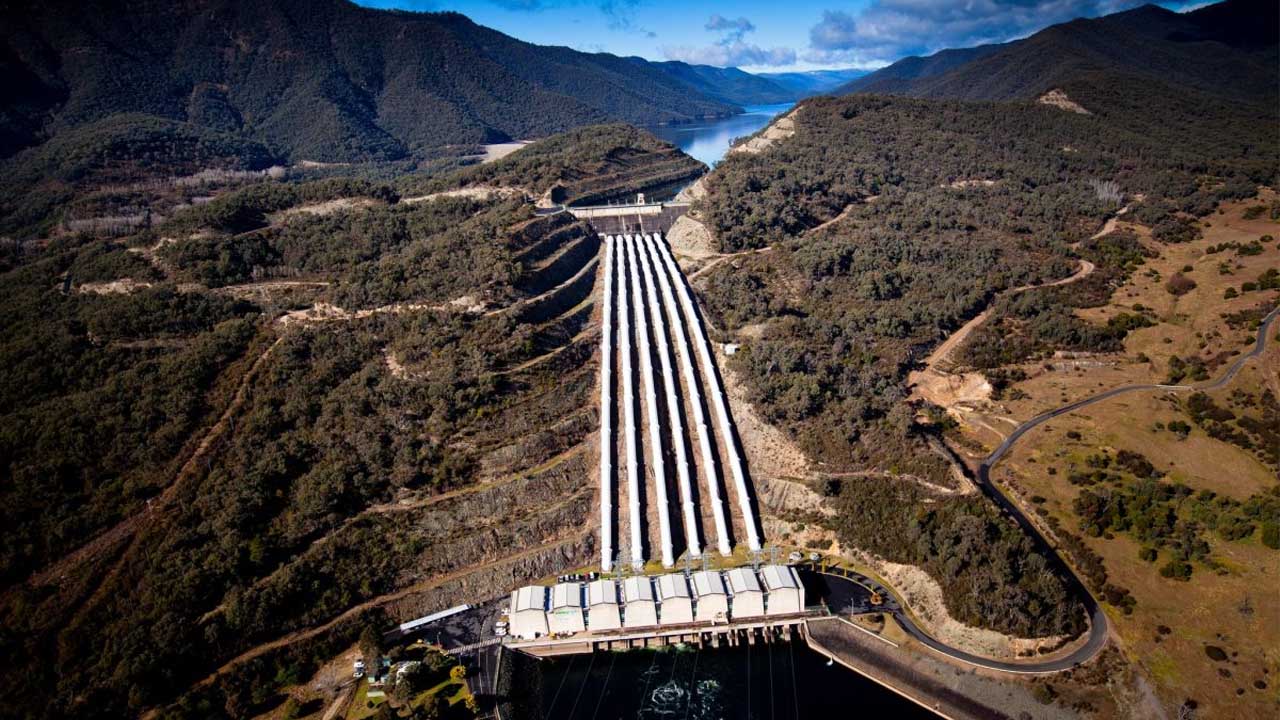
Tantangara Reservoir sits high in the alpine plateau. Talbingo Reservoir lies more than 700 metres lower in elevation. Engineers designed a network of 27 kilometres of underground tunnels to connect the two. When solar farms or wind parks generate excess electricity, the facility powers pumps that push water uphill from Talbingo to Tantangara. When energy demand peaks, operators release that water downhill through turbines, converting gravitational force into electricity sent to the national grid.
At full capacity, Snowy 2.0 aims to deliver 2,200 megawatts of dispatchable power, enough to supply roughly three million homes during peak output. The system offers 350,000 megawatt-hours of storage, which allows continuous generation at maximum capacity for nearly a week. No battery facility on the Australian grid yet approaches that scale.
Energy analysts cite Snowy 2.0 as one of the largest pumped-hydro storage projects under construction in the world, rivaled only by mainland Chinese developments such as Fengning Pumped Storage Power Station and Huizhou Pumped Storage Facility.
On paper, the design solves the intermittency problem faced by wind and solar power. In reality, construction brought challenges that no feasibility report fully predicted.
Why the Costs Exploded?
Early projections underestimated geological complexity and construction risk. Chief engineers soon realized that the rock beneath the Snowy Mountains varied dramatically between sedimentary layers and fractured granite zones. Tunnel boring machines advanced at uneven speeds as crews encountered collapsing pockets, water inflows, and unstable ground that demanded extensive reinforcement.
The project deployed three tunnel-boring machines named Florence, Kirsten, and Lady Eileen Hudson. Florence encountered major instability only months after launch in 2021. The surrounding ground collapsed. A nine-metre sinkhole opened above the tunnel alignment in 2022. Crews worked more than a year to stabilize the area and free the trapped machine.
These failures forced design changes, safety reviews, contractor restructuring, and extended downtime that pushed costs upward. Snowy Hydro approved the introduction of a fourth tunnel-boring machine in 2024 to accelerate excavation after repeated delays. Transport logistics, workforce housing, waste handling facilities, and emergency ventilation upgrades all added to project expenses.
Labor shortages and rising prices for steel, explosives, heavy machinery, and fuel compounded inflation pressures across the supply chain. Estimates from the Australian National Audit Office and parliamentary budget committees identified early scope optimism and limited contingency planning as drivers behind the ballooning budget.
Environmental Pressure Inside a National Park
Construction unfolds inside Kosciuszko National Park, an ecologically sensitive alpine region protected under state conservation law. Excavation generates millions of tonnes of spoil rock that required off-site processing and relocation.
Testing revealed acid-forming minerals and asbestos traces in some excavated material. Improper handling raised concerns about groundwater contamination and sediment impacts on the reservoirs. Tunneling also intersected aquifers that could lower natural water tables by up to 50 metres, threatening alpine bog systems that support endemic species such as the corroboree frog and mountain pygmy possum.
Environmental monitoring authorities now require extensive groundwater observation and rehabilitation plans. Critics argue these measures arrived only after construction had advanced too far to avoid serious ecological disruption.
Underground Safety Concerns
Worker safety became a national topic after toxic gas incidents inside the tunnels in 2023, forcing emergency evacuations. Investigators traced the exposure to methane pockets and insufficient real-time air quality detection systems during early excavation phases.
No fatalities occurred, yet union safety bodies demanded stronger compliance oversight. Updates followed with added ventilation shafts, additional rescue drills, and 24-hour atmospheric monitoring teams. Despite improvements, underground work continues under high-risk classifications due to the remote alpine location and unpredictable ground conditions.
Public Perception and Transparency
Each delay and budget revision further strained public trust. Local residents near Cooma voiced frustration over infrastructure pressures without corresponding long-term employment security. National energy experts criticized Snowy Hydro for optimistic delivery statements that underestimated setbacks.
Parliamentary hearings questioned project transparency after financial forecasts shifted several times within single budget cycles. Many Australians now see Snowy 2.0 as a cautionary tale about megaproject governance rather than a clean energy triumph.
A Changed Storage Market
Energy storage technology advanced faster than policy planning assumed in 2017. Grid-scale lithium battery installations now operate across South Australia, New South Wales, and Victoria. Facilities such as the Hornsdale Power Reserve, Victorian Big Battery, and Kurri Kurri battery projects demonstrate rapid deployment timelines measured in months rather than years.
Battery costs dropped sharply due to manufacturing expansion in China and increased competition in mineral supply chains. Integrated software controls allow batteries to respond within milliseconds to grid fluctuations. Pumped hydro responds slower and requires massive upfront capital investment.
Energy market analysts from CSIRO and the Australian Energy Market Operator now assess that modular batteries and demand-side response tools satisfy much of the storage demand that Snowy 2.0 was originally designed to serve.
Strategic Value Remains
Snowy 2.0 still offers one advantage that batteries cannot yet match at national scale: long-duration storage. Batteries typically provide two to four hours of energy output. Snowy 2.0 can discharge continuously for days. During extended wind or solar droughts, long-duration assets stabilize grid frequency without reliance on fossil fuels.
Federal energy modeling continues to include pumped hydro as part of net-zero pathways, although analysts now question whether the scale chosen for Snowy 2.0 exceeded what Australia truly required.
Also Read: 5 Mega Projects That Could Transform Afghanistan’s Future
A Defining Moment for Australian Infrastructure
Snowy 2.0 stands at a crossroads. Success would secure a landmark energy asset capable of supporting a renewable-led grid for decades. Failure would define it as one of the most expensive planning miscalculations in Australian infrastructure history.
The tunnels continue advancing. Turbine housings take shape beneath the mountains. Transmission corridors expand toward major grid interconnectors in New South Wales and Victoria. Progress inches forward, fueled by sunk costs and national reputation.
I returned to the Snowy work zone and felt the hum of generators echo through the rock. You can sense both pride and uncertainty in equal measure. This project carries hope stitched tightly to risk, ambition bound to consequence, and engineering courage tested under unprecedented pressure.