
Rise Tower and the Mathematics Behind Saudi Arabia’s Vertical Megaproject Ambition
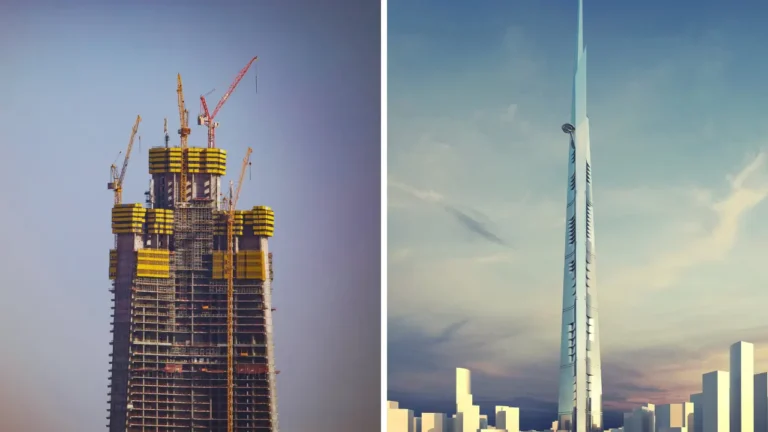
Saudi Arabia is reshaping global architecture with projects that challenge accepted limits of scale and engineering. Across vast desert landscapes, new urban districts now rise where empty terrain once stretched uninterrupted. Designers have proposed a perfectly straight 170-kilometer city known as The Line. Developers have advanced work on Jeddah Tower, planned to exceed 1,000 meters in height after years of suspension. Engineers have sketched an even bolder vision called Rise Tower, a proposed vertical colossus expected to reach an unprecedented two kilometers into the sky.
I first studied these blueprints expecting dramatic shapes and architectural symbolism. What caught my attention instead was the overwhelming presence of math. Every decision behind these megastructures begins with calculations measured in decimals and probability curves. Designers cannot rely on aesthetics or ambition alone. Precision determines survival at this scale. Without equations controlling every load path, airflow pattern, and vibration curve, none of these buildings could stand. I invite you to see this world through the same lens I did, standing mentally inside those planning rooms where numbers quietly rule the skyline.
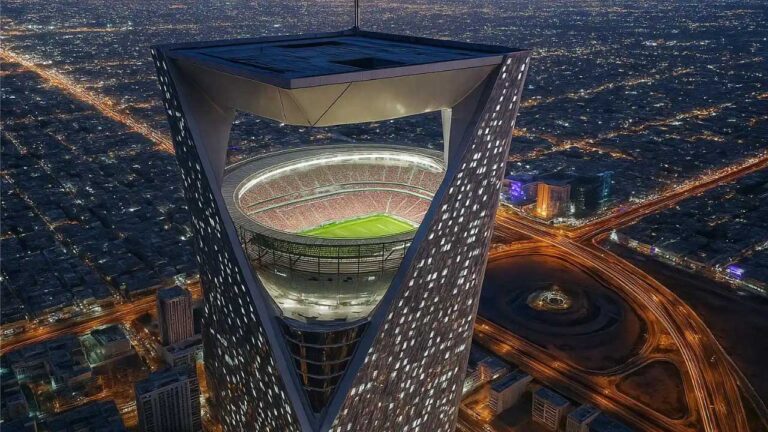
Rise Tower sits at the extreme end of Saudi Arabia’s vertical vision. Proposed as a two-kilometer-tall tower with roughly 678 occupiable floors, the structure would stand twice as tall as Burj Khalifa and nearly twice the planned height of Jeddah Tower. Concept plans describe space for residences, offices, hotels, public parks, medical facilities, schools, and transit hubs, forming a true vertical city designed to support hundreds of thousands of daily occupants. Upper terraces would extend beyond the cloud line, exposing visitors to shifting atmospheric conditions unknown to any existing building.
Also Read: Why MrBeast Built His First Theme Park in Saudi Arabia
Structural Integrity and the Math of Staying Upright
Every skyscraper begins with the same question. How do you resist gravity. The taller a building grows, the larger its accumulated dead load becomes. Engineers calculate this weight in millions of metric tons. They factor in steel frames, concrete cores, mechanical systems, glazing, elevators, furniture, water storage circuits, and human occupancy. Each addition compounds the strain placed on the lower structure.
Wind defines the next major force. At two kilometers above ground, average wind speeds exceed anything encountered by buildings today. Turbulence amplifies pressure against the facade and induces movement within the tower core. Engineers model these conditions using computational fluid dynamics. Those simulations calculate vortex shedding frequencies that could cause dangerous oscillations. They test thousands of possible tower shapes to minimize aerodynamic drag and disruption.
Seismic resistance adds another layer of calculation. Though Saudi Arabia experiences limited seismic risk compared to regions like Japan or California, a tower of this size demands full earthquake modeling. Engineers use dynamic structural analysis to map how seismic waves would propagate through the foundation and upward across thousands of meters of structure.
Digital twin technology drives modern mega-construction analysis. A fully integrated virtual model predicts how the building responds to stress throughout its projected lifespan. Engineers simulate everything from storm systems and temperature fluctuations to long-term material fatigue. Sensors embedded in concrete test sections validate every assumption before full-scale production begins. The concrete itself must exceed present strength records, incorporating ultra-high-performance blends reinforced with fiber composites to prevent microfractures under sustained loads.
Engineers perform these calculations endlessly because even fractional missteps could cascade into structural failure. Every joint, damper, and beam placement emerges from verified numerical safety margins.
Turning Height into a Livable City
A two-kilometer structure fails unless people can move through it efficiently. Vertical mobility planning rivals aviation-level complexity. Designers now adapt algorithms similar to air traffic management for elevator control. High-speed cars travel in synchronized banks, stopping selectively at sky lobbies that redistribute traffic across bundled elevator shafts.
Some sections will integrate multi-directional cab systems capable of lateral shifts along horizontal tracks. This technology, adapted from magnetic levitation rail concepts, permits elevator pods to switch shafts or cross between structural compartments without mechanical transfer points. This approach avoids the bottleneck problem that traditionally limits skyscraper scaling.
Water movement stands as another mathematical challenge. Pumping water vertically across two kilometers requires segmented pressure zones regulated by advanced hydraulic modeling. Engineers divide the building into stacked systems, where gravity storage tanks supply localized pressure for clusters of floors. This approach prevents pipe rupture risks and reduces energy loads tied to continuous pumping.
Climate control systems follow similar logic. Atmospheric pressure differences change measurably across two kilometers of altitude. Temperature gradients generate internal air convection currents capable of destabilizing comfort conditions. Engineers conduct airflow modeling to maintain uniform climate control, balancing ventilation circulation and energy conservation metrics. Heat recovery loops and geothermal integration reduce operational footprints while maintaining stability across stacked thermal zones.
Each technical decision evolves from calculated response curves rather than design preference.
Designing for Human Behavior
Architecture serves people before anything else. Engineers analyze biometric movement data to optimize human flow inside the tower. Software simulates millions of pedestrian route choices. These simulations determine the placement of staircases, escalators, shopping corridors, emergency exits, and vertical transfer decks.
Crowd density modeling protects safety by preventing choke points during peak transit hours. Evacuation path calculations simulate emergency scenarios to ensure total egress time remains within international safety standards despite the unprecedented height.
Interior acoustics require equally meticulous analysis. In large-volume spaces, sound reverberation can multiply rapidly. Engineers model acoustic wave dispersion to calculate optimal wall thicknesses, material blends, and sound barrier geometry. These simulations prevent echoes from traveling across atriums or corridor clusters.
Natural light penetration presents another variant of human-based modeling. Shadow mapping tools calculate sunlight angles throughout the year. Engineers modify window spacing, glazing coatings, and light shaft placement to ensure adequate daylight reaches internal spaces without overheating occupied areas.
Smart building systems now sync these functions using real-time algorithms. Occupancy sensors allow lighting, cooling, ventilation, and elevator service to adjust continuously based on usage patterns. Individual residences respond automatically to residents as they return, adjusting environment controls without manual input.
These systems convert the building into an intelligent habitat where equations continuously refine comfort.
Materials, Sustainability, and Carbon Accounting
At megastructure scale, sustainability depends on arithmetic discipline. Engineers calculate embodied carbon for every component from steel production and concrete curing to logistics across supply chains. Life-cycle assessments identify the lowest-footprint alternatives without compromising safety or durability.
Operational energy modeling drives the installation of renewable systems tied to integrated solar facades, geothermal exchange arrays, and district-level power optimization protocols. Smart microgrids allocate energy dynamically based on real-time demand forecasting rather than static load supply.
Waste heat recovery recaptures thermal energy from vertical transportation systems and mechanical infrastructure. Greywater recycling models constantly refine reuse loops for irrigation and cooling. AI-controlled maintenance scheduling reduces material replacement cycles and prevents efficiency degradation.
Sustainability at this scale emerges only through relentless metrics applied continuously across decades of operation.
Geopolitical and Economic Context
Saudi Arabia frames megaprojects like Rise Tower as economic diversification engines under Vision 2030. Tourism, financial services, residential relocation, and technology investment represent targeted growth pillars beyond fossil fuel revenues. Vertical megastructures aim to cluster economic activity in globally visible centers capable of competing with Dubai, Singapore, Hong Kong, and Shanghai.
Financial viability depends on foreign investment confidence backed by engineering credibility. Demonstrating structural feasibility becomes itself a diplomatic instrument. Completed megaprojects send a message of reliability and ambition across global markets.
Yet risks persist. Construction at this magnitude demands sustained capital flows and uninterrupted political stability. Jeddah Tower illustrates the vulnerability of megaproject timelines to internal and external economic disruptions. Restarted construction has resumed after years of delays amid shifting market conditions. Lessons from that project now inform updated feasibility assessments for future towers exceeding known limits.
Math That Never Stops
Even after completion, predictive simulations remain active. Engineers run continual stress modeling against live building sensor data. Algorithms forecast component fatigue and schedule reinforcement or maintenance long before degradation becomes visible. Weather prediction systems integrate into structural monitoring platforms to preemptively stabilize sway dampers before extreme wind events.
Population curve modeling adjusts interior zoning over decades as residential and commercial demand shifts. Modular retrofitting systems planned into the structure allow interior spaces to evolve without major structural alterations.
The building never stops solving itself.
Also Read: Dubai’s $35BN New Airport Will Change Air Travel Forever
The Equations Behind the Dream
When people imagine a structure like Rise Tower, they picture shimmering glass facades piercing the clouds. I picture the mathematics that keep the glass suspended against gravity and stormforce winds. You may never see the probability matrices calculating sway thresholds or the hydraulic formulas governing water distribution zones, yet they form the only reason such a building could exist.
Saudi Arabia’s emerging skyline reflects not only ambition and economic strategy but also the quiet authority of engineering precision. Steel and concrete create the physical mass. Math creates the stability, comfort, sustainability, and safety that allow that mass to function as human habitat.
Rise Tower represents the purest expression of this principle. It is not simply a skyscraper scaled beyond precedent. It is a solved equation extended vertically into the sky.
The future of megacities depends less on spectacle than on calculation. Cities rise when numbers permit them to stand. Every extraordinary tower ascends because the mathematics beneath it never falters.