
Dubai’s $30 Billion Ghost Megaproject Is Finally Back
Palm Jebel Ali Is Rising Again
Building land in the middle of the sea pushes engineering to its limits. It tests money, patience, and belief at the same time. For almost two decades, Palm Jebel Ali stood as Dubai’s most visible failure. You could spot its outline from space, yet nothing moved on the ground. It stretched across 13 square kilometres like a frozen idea, shaped during a boom and abandoned during a collapse that shook global markets. In 2008, construction stopped overnight. Investors pulled out. Equipment disappeared. The sea slowly pushed back against the artificial shoreline, erasing parts of what humans had forced into existence.
Today, that silence has broken. Dredgers roar across the Persian Gulf. Construction crews return in full force. Billions of dollars flow back into a project many had already written off. Palm Jebel Ali is no longer a ghost. It stands at the center of Dubai’s long-term growth plan, tied directly to the Dubai 2040 Urban Master Plan, which aims to expand livable space, public beaches, and high-value real estate. I remember looking at satellite images years ago and thinking this place would never recover, yet now it feels like watching a second life unfold in real time.
Also Read: Can China Turn Pakistan’s $60 Billion Mega Port into the Next Dubai?
A Scale That Redefines Coastal Cities
Palm Jebel Ali does not try to compete with Palm Jumeirah. It surpasses it in every measurable way. The island spans about 13.4 square kilometres, making it more than twice the size of its predecessor. It adds over 110 kilometres of coastline, a number that reshapes Dubai’s entire waterfront strategy. This expansion alone increases public beach access by nearly 400 percent, according to Dubai Municipality planning projections.
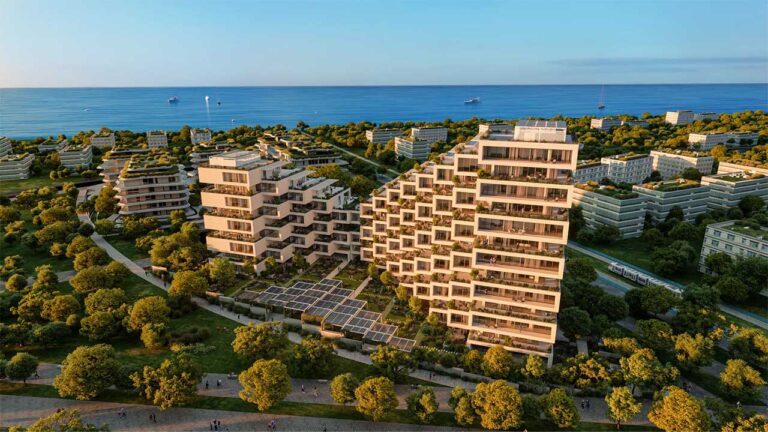
The island will support more than 200,000 residents. That places it in the same category as mid-sized global cities like Geneva. Developers designed it with a central trunk, 16 wide fronds, and a crescent-shaped barrier that wraps around the entire structure. Each frond offers deeper plots and larger villas compared to Palm Jumeirah. Developers shifted their focus from high density living to ultra-premium space. You see fewer buildings packed together and more emphasis on privacy, waterfront views, and long-term value.
Dubai Land Department data shows that demand for beachfront property continues to rise, especially among international buyers from Europe, Russia, China, and the Middle East. This demand drives the logic behind Palm Jebel Ali. The city had already exhausted prime beachfront inventory on Palm Jumeirah. Expansion was not optional. It became necessary.
Why the Sea Fights Back
Before construction begins, engineers face a simple truth. The sea does not accept artificial land easily. Every wave, every tide, and every current works against stability.
The first challenge starts with sand. Dubai sits in the middle of a desert, yet desert sand cannot support construction. Wind shapes desert grains into smooth, rounded particles. These particles slip over each other and fail to lock into place. Engineers call this aeolian sand, and it behaves like tiny ball bearings under pressure.
To build a stable foundation, crews rely on marine sand taken from the seabed. Water movement creates rough, angular grains that interlock under compression. This property gives the sand strength and stability. Dredging companies like Jan De Nul and Van Oord lead these operations, using trailing suction hopper dredgers to extract and transport millions of cubic meters of material from offshore zones approved by environmental authorities.
The Precision of Rainbowing
Once dredgers collect the sand, the real spectacle begins. Engineers use a method called rainbowing to place it. Ships pump a mixture of sand and seawater through large nozzles, launching it into the air in controlled arcs that can reach up to 150 meters.
This process looks dramatic, but it relies on precise calculations. GPS systems guide every movement. Engineers map the island in digital grids and assign exact coordinates for each sand layer. Crews build the island gradually, starting from the seabed and working upward until the structure rises above sea level.
Each pass adds volume, shape, and elevation. Survey teams constantly monitor accuracy using satellite positioning and sonar data. Even small errors can distort the entire layout of the fronds. This level of precision ensures that roads, villas, and infrastructure align perfectly with the master plan later on.
Turning Soft Ground Into Solid Land
Freshly placed sand cannot support buildings. At this stage, the island behaves like a water-filled sponge. Any heavy load can trigger liquefaction, a process where the ground loses strength and starts to flow like a liquid.
Engineers solve this problem through vibro-compaction. They use long steel probes that penetrate deep into the sand. These probes vibrate at high frequencies, forcing water out and pushing sand grains closer together. As the probe moves upward, it leaves behind dense columns of compacted soil.
This method improves load-bearing capacity and reduces settlement risk. It also prepares the ground for roads, utilities, and heavy structures. The process takes time and consumes significant energy, yet it remains essential. Without it, no building on Palm Jebel Ali could stand safely.
Research from the American Society of Civil Engineers highlights vibro-compaction as one of the most effective ground improvement techniques for reclaimed land. Dubai applied the same principle on Palm Jumeirah, and engineers refined it further for Jebel Ali.
The Breakwater That Protects Everything
No artificial island survives without protection. Palm Jebel Ali relies on a massive crescent-shaped breakwater that stretches roughly 17 kilometres. This structure shields the island from waves, storms, and long-term erosion.
Crews build the breakwater in layers. The outer layer consists of heavy armor rock, with individual stones weighing up to six tonnes. Quarries in the Hajar Mountains supply these rocks. Beneath this layer, engineers place smaller stones and geotextile membranes that stabilize the structure and prevent sand from washing away.
This design does more than block waves. It also manages water flow. Engineers included openings in the crescent to allow tidal movement. These gaps let fresh seawater circulate through the inner lagoons every two weeks, preventing stagnation and maintaining water quality.
Environmental experts raised concerns during earlier projects about marine ecosystems and water stagnation. This updated design addresses those concerns with better circulation and monitoring systems, aligned with guidelines from UAE environmental authorities.
The Years When Everything Stopped
By 2008, Palm Jebel Ali had taken shape. The outline was clear. The engineering worked. Then the global financial crisis hit.
Dubai’s real estate market collapsed under heavy debt and falling demand. Nakheel, the developer behind the Palm projects, faced billions in liabilities. Construction halted. Contracts froze. Investors waited without answers.
For nearly 15 years, Palm Jebel Ali remained incomplete. The site attracted curiosity, criticism, and speculation. Some called it a symbol of overreach. Others saw it as a paused opportunity waiting for the right moment.
Satellite images during this period showed erosion in some sections, yet the core structure remained intact. This durability proved that the engineering foundation had succeeded, even if the financial model had failed at that time.
Why Dubai Restarted the Project
Dubai did not restart Palm Jebel Ali out of nostalgia. It responded to a clear shift in global demand.
After 2020, high-net-worth individuals began relocating to cities that offered stability, safety, and tax advantages. Dubai positioned itself as a top destination. Property demand surged, especially for waterfront homes.
Palm Jumeirah reached capacity. Prices crossed $4,000 per square foot in prime areas, according to market reports from Knight Frank and CBRE. Buyers still wanted beachfront living, yet supply had run out.
This gap turned Palm Jebel Ali into a strategic asset. In 2023, Dubai relaunched the project with a revised master plan. The new vision includes smart infrastructure, renewable energy integration, and improved transport links. In 2025, authorities awarded contracts worth over AED 750 million to build core infrastructure, including roads, drainage, and power networks.
Market data shows strong response. Palm Jebel Ali accounted for a significant share of luxury property transactions soon after launch. Buyers moved quickly, driven by limited supply and long-term value expectations.
Also Read: HS2: Britain’s £106 Billion Railway Disaster Explained
More Than an Island, A Test of Legacy
Palm Jebel Ali represents more than engineering ambition. It reflects how Dubai handles failure and recovery. The city paused, reassessed, and returned with stronger financial backing and clearer demand.
Construction continues, with the first residential handovers expected around 2027. Developers now focus on creating livable communities, not just iconic shapes. Schools, healthcare facilities, retail zones, and transport networks will determine long-term success.
You can build land with sand and machines. You build a city with people, trust, and time. Palm Jebel Ali has already proven that Dubai can shape the sea. The next challenge lies in proving that this massive investment can sustain value across decades, not just market cycles.
Standing at the edge of this project today, you do not see a failure anymore. You see momentum, risk, and belief moving in the same direction.