
Inside the Mountain Megaproject: Asia’s Largest Underground Hydropower Plant
Picture a power station so vast it rivals a city, yet you never see it on the skyline. No towers, no chimneys, no visible turbines. Instead, it sits buried hundreds of meters inside a mountain, operating in silence while feeding electricity to some of the most power-hungry regions on Earth. This is not a concept or a vision for the future. It is real, operational, and already reshaping Asia’s energy backbone. I remember standing near the dam crest and feeling the ground vibrate faintly beneath my feet, knowing an entire industrial world was working deep below the rock.
A Giant Hidden Beneath the Jinsha River
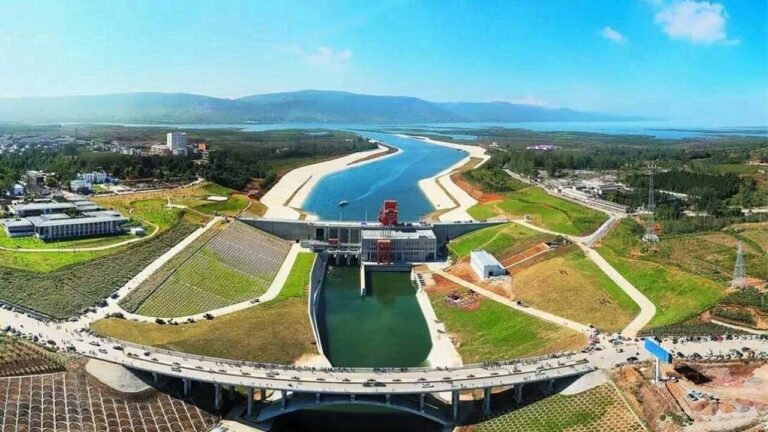
This underground megaproject is the Baihetan Hydropower Station, located on the Jinsha River, the upper section of the Yangtze, at the border of Sichuan and Yunnan provinces. The river cuts through steep gorges shaped by tectonic movement and erosion over millions of years. Engineers chose this location for one reason above all others. It offers extreme vertical drop, stable abutments for an arch dam, and a flow regime capable of sustaining year-round power generation.
The surface landmark is the Baihetan arch dam itself, rising roughly 289 meters above the riverbed. It ranks among the tallest concrete arch dams ever built. Yet the dam only tells half the story. The real megastructure sits invisibly inside the mountains flanking the river. Buried more than 300 meters underground, the power station complex supports an installed capacity of 16 gigawatts. This places Baihetan among the most powerful hydropower plants on the planet, alongside Three Gorges and Itaipu.
China officially connected the first generating units to the grid in 2021. Full commissioning followed in 2022, marking a major milestone in the country’s west to east energy transfer strategy.
Also Read: Why China Is Building Ports Across the Caribbean Near the United States
Why Engineers Chose to Build Underground
Engineers did not hide Baihetan’s power station underground for aesthetic reasons. Geology, safety, and system reliability drove that decision from the start. Housing turbines and transformers inside solid rock provides natural protection against landslides, extreme weather, and external threats. It also delivers structural confinement against enormous hydraulic pressure. At peak operation, internal pressures exceed 10 megapascals, a force that would demand massive surface structures if left exposed.
The Jinsha River corridor also sits within a seismically active zone. Underground caverns anchored in competent rock behave far better during earthquakes than surface buildings. The surrounding rock mass absorbs seismic energy, reducing stress concentrations on critical equipment. This approach lowers long term maintenance risk and improves operational stability over decades.
Environmental impact played a role as well. Underground powerhouses reduce surface excavation, preserve river valley landscapes, and minimize visible industrial footprint in a sensitive mountain region.
Excavating a City from Solid Rock
Before installing a single turbine, crews had to carve an underground complex of extraordinary scale. Construction teams removed more than 25 million cubic meters of rock. Much of this excavation passed through hard basalt and granite, materials that resist cutting even with modern equipment.
Controlled drilling and blasting advanced slowly. Engineers often progressed no more than one or two meters per day. They prioritized stability over speed, since excessive vibration could fracture surrounding rock and trigger collapse. High in situ stress meant that freshly exposed cavern walls immediately began to deform inward.
Working conditions tested human limits. Underground temperatures regularly exceeded 40 degrees Celsius. Humidity stayed high. Ventilation shafts and cooling systems had to be installed early just to keep excavation possible. Crews worked in rotating shifts, supported by continuous geological monitoring.
To stabilize the caverns, teams installed more than 100,000 rock bolts, steel ribs, and prestressed anchors. Layers of sprayed concrete locked fractured zones together. The finished underground layout stretches for several kilometers and includes turbine halls exceeding 80 meters in height, transformer caverns, access tunnels, drainage galleries, and ventilation networks. The result resembles a hidden industrial city embedded inside the mountain.
Battling Geology in Real Time
Geology dictated every decision at Baihetan. The site lies near active fault systems that continue to move by millimeters each year. Engineers conducted high resolution geological surveys using seismic imaging, borehole sampling, and 3D modeling long before excavation began.
Even with advanced mapping, surprises emerged. Fault zones intersected planned tunnel alignments. Some rock sections fractured unexpectedly under stress. In those areas, engineers increased reinforcement density and altered cavern geometry to distribute loads more evenly.
Groundwater proved just as dangerous. Under high pressure, seepage can erode rock and weaken support systems. Engineers built extensive drainage tunnels to relieve pressure gradually. These galleries channel water safely away from the main caverns, preventing uncontrolled inflows that could threaten structural integrity.
Sensors monitored rock movement and water pressure continuously. Construction became an ongoing dialogue between data and decision making, where engineers adjusted methods daily to match conditions inside the mountain.
The Turbine Hall at the Core
At the center of the complex sits the turbine hall, one of the largest underground power caverns ever constructed. Inside, 16 Francis turbines line the floor, each rated at 1,000 megawatts. Each turbine assembly weighs more than 8,000 tons and operates under tightly controlled hydraulic conditions.
Water enters through high pressure headrace tunnels connected to the reservoir behind the dam. It drops more than 200 meters before striking the turbine runners. Flow rates exceed 700 cubic meters per second per unit at full load. Engineers regulate this flow with extreme precision to prevent cavitation and fatigue damage.
After transferring its energy, the water exits through tailrace tunnels and returns to the Jinsha River downstream. Gravity drives the entire cycle. No fuel burns. No emissions rise from the site.
Feeding Power Across a Continent
Baihetan generates over 62 billion kilowatt hours of electricity each year. This output supplies major demand centers along China’s eastern seaboard, including parts of Jiangsu, Zhejiang, and Guangdong provinces.
To move power over such vast distances, China relies on its ultra high voltage direct current network. Baihetan connects to ±800 kilovolt transmission lines capable of carrying electricity more than 2,000 kilometers with minimal losses. State Grid Corporation of China developed these lines specifically to link remote generation sites with coastal megacities.
This energy replaces an estimated 20 million tons of coal annually. It cuts carbon dioxide emissions by more than 50 million tons each year, according to China Three Gorges Corporation, the project owner and operator.
Intelligence Embedded in the Structure
Modern hydropower at this scale demands constant awareness. Baihetan integrates thousands of sensors that track vibration, temperature, pressure, and minute structural movement. Operators monitor turbine behavior in real time from centralized control rooms.
Machine learning systems analyze data trends to predict maintenance needs. These systems detect subtle deviations long before they escalate into failures. This approach allows Baihetan to maintain high availability despite operating near maximum output for extended periods.
Built to Endure Earthquakes
Seismic safety guided design from day one. Historical records show earthquakes exceeding magnitude seven in the region. Instead of resisting seismic forces rigidly, engineers designed flexibility into the system.
The surrounding rock absorbs much of the energy. Structural joints allow controlled movement without cracking. Turbine foundations isolate vibration to prevent resonance. In testing and simulation, this combination reduced peak stress loads significantly compared to surface installations.
Here, the mountain itself functions as a protective shell.
Designed for a Century of Operation
Baihetan carries a design lifespan exceeding 100 years. Engineers selected corrosion resistant alloys for turbine runners and penstocks. Cavern linings account for long term rock creep and stress redistribution. Modular turbine components allow future upgrades without major reconstruction.
Over decades, this plant will anchor regional energy stability, support industrial output, and reduce reliance on fossil fuels.
Influence Beyond Power Generation
The lessons learned at Baihetan extend far beyond hydropower. Construction techniques developed here now inform underground pumped storage plants, deep transportation tunnels, and urban subsurface infrastructure projects worldwide.
As surface land grows scarce, nations increasingly look underground for solutions. Baihetan shows what becomes possible when engineers combine geological understanding with disciplined design.
Also Read: Saudi Arabia Wants to Build a City Underwater
The Invisible Achievement
Thousands of engineers, geologists, and workers built Baihetan under conditions few ever experience. They worked long shifts in heat, darkness, and constant geological pressure. Their success reflects decades of accumulated expertise refined through practice, not theory.
You may never see Baihetan unless you study satellite images or technical drawings. Yet every time millions of homes light up, this hidden machine does its work quietly inside the mountain.
Baihetan does more than generate electricity. It proves that infrastructure does not always rise upward to shape the future. Sometimes, it disappears into the rock and reshapes what humanity believes it can build when vision meets discipline and depth becomes an asset rather than a barrier.