
America’s $22 Billion Plan to Rebuild Dulles Airport: Can the United States Still Build Mega Projects?
Washington Dulles International Airport was designed to represent the future of American aviation. When it opened in 1962, its sweeping terminal architecture and innovative passenger transportation system made it one of the most forward-thinking airports in the world. More than six decades later, however, the airport has become a symbol of America’s growing struggle to modernize its infrastructure.
While international competitors such as Doha’s Hamad International Airport, Singapore Changi Airport, and Dubai International Airport have invested heavily in modern terminals and passenger facilities, Dulles continues to rely on an outdated transportation system. Its mobile lounges, originally introduced in the 1960s, still transport passengers between the main terminal and aircraft gates. The vehicles frequently experience mechanical problems, and the journey can cover distances of half a mile.
Now, the United States is considering a $22 billion transformation of its international gateway. The proposed redevelopment would replace outdated concourses, introduce entirely new terminal facilities, and reshape the airport for future generations of air travel. Twenty-one leading architectural firms have submitted proposals, with a target completion date of 2034.
The ambition is considerable, but so are the challenges. Beyond the financial commitment, the project raises a much larger question: can the United States still deliver major infrastructure projects with the speed and efficiency that once defined its engineering achievements?
How Dulles Airport Fell Behind the Rest of the World
The story of Dulles begins in the late 1950s, when architect Eero Saarinen was commissioned to design an airport unlike anything the United States had seen before.
His vision was revolutionary. The main terminal featured a dramatic curved roof that appeared to evoke the movement of flight. Rather than relying on conventional passenger corridors and jet bridges, Saarinen introduced mobile lounges that transported travelers directly between the terminal and their aircraft.
At the time, the concept represented the future of airport design. Passengers could board enclosed vehicles inside the terminal and travel directly to their planes without walking through long corridors or navigating conventional boarding bridges.
However, commercial aviation developed much faster than the original design anticipated. Aircraft became larger, passenger volumes increased, and international air travel expanded dramatically.
Instead of replacing the original transportation system with a unified modern alternative, Dulles gradually accumulated different solutions.
Also Read: The $5B Pipeline That Could Have Saved India
An underground AeroTrain system was introduced, although it does not serve every concourse. Conventional jet bridges were installed at some gates, while mobile lounges continued operating at others.
The result is an airport with three different passenger transportation systems that do not work particularly well together.
The shortcomings became increasingly difficult to ignore. In 2025, a mobile lounge was involved in a crash that injured 18 people, further highlighting the problems associated with maintaining an aging transportation system.
The airport authority had previously proposed a $7 billion modernization strategy spread across 75 years, with the gradual elimination of mobile lounges targeted for completion by 2100. Donald Trump considered the approach inadequate, arguing that Dulles needed a much more ambitious transformation.
The proposed $22 billion redevelopment represents a fundamentally different approach: rather than spending decades gradually addressing individual problems, the United States wants to rebuild the airport on a much larger scale.
A 70-Year-Old Airport Vision That Was Never Completed
One of the most interesting aspects of the Dulles redevelopment is that the airport’s original design was never fully realized.
When Eero Saarinen developed his masterplan in 1958, he envisioned six terminals arranged in a sweeping formation across the Virginia countryside. The design was intended to accommodate the enormous growth of commercial aviation over the decades that followed.
However, only one of those terminals was constructed.
The foundations intended for the remaining terminals are still buried beneath the airport’s runways, leaving much of Saarinen’s original vision unrealized.
This historical detail changes the way the current redevelopment should be understood. The proposed transformation is not simply an attempt to modernize an aging airport. It also represents an opportunity to revisit a masterplan conceived nearly seven decades ago.
In many ways, the United States is attempting to complete a vision that began in the 1950s, when commercial aviation was entering a period of extraordinary expansion.
The irony is that while Dulles remained constrained by its original infrastructure, other countries built entirely new aviation hubs designed around the demands of modern international travel.
Inside the $22 Billion Dulles Airport Redevelopment Plan
In December 2025, the US Department of Transportation issued an open call inviting leading architectural firms to submit proposals for a complete transformation of Dulles.
The objective was ambitious: construct new terminals, replace existing concourses, modernize passenger facilities, and turn the airport into an international gateway capable of competing with the world’s leading aviation hubs.
The administration also demanded that the project move forward at what it described as the “speed of Trump.”
The response was significant. Twenty-one proposals arrived within six weeks, offering different visions for the future of the airport.
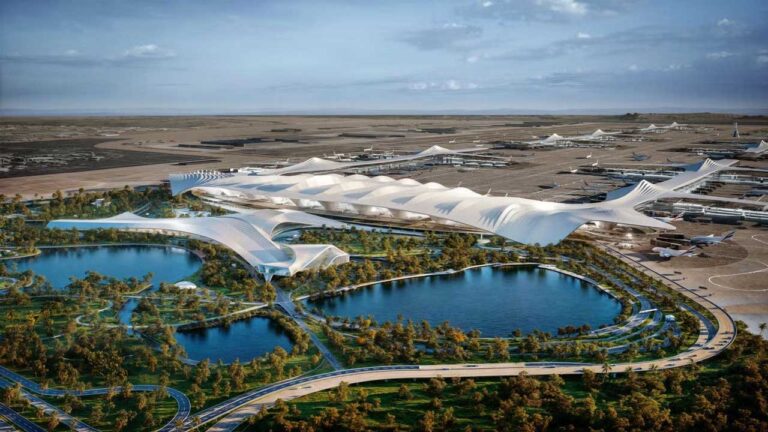
Among the submissions was a proposal from Zaha Hadid Architects featuring a sweeping curved terminal called the Donald J. Trump Terminal. Grimshaw presented an alternative design featuring an accordion-style ceiling and what it described as a state-of-the-art airport processor, supported by a broader masterplan.
Ferrovial, the infrastructure company involved in operating major airports including Heathrow and JFK, proposed an Airport City concept surrounding the new terminal.
The proposals also revealed how expensive the transformation could become. One firm estimated that a near-complete reconstruction could cost between $35 billion and $50 billion.
The plan that emerged carried a proposed price tag of $22 billion.
Its financing structure included $21.8 billion in new bonds and $1.1 billion in airport fees. The target completion date was set for 2034.
That would leave approximately eight years to transform an operational airport handling around 29 million passengers annually.
Maintaining normal airport operations while replacing major infrastructure presents a substantial engineering and logistical challenge. Construction would need to proceed without bringing the airport’s existing passenger and airline operations to a standstill.
The ultimate ambition is to create an airport capable of competing with Doha, Singapore, and Dubai while restoring America’s reputation as a global leader in aviation infrastructure.
Why Major Infrastructure Projects Take So Long in America
Dulles is part of a much larger debate about America’s ability to deliver major infrastructure projects.
International comparisons highlight the growing difference between the construction timelines of American infrastructure and those of several competing aviation hubs.
Doha’s Hamad International Airport was developed over approximately ten years at a reported cost of $15.5 billion, although the project also experienced years of delays.
Singapore’s Jewel Changi was completed in four years, while Dubai expanded Terminal 3 in five.
In the United States, however, major airport projects have frequently taken considerably longer.
The new terminal redevelopment at LaGuardia Airport took approximately 12 years and cost $8 billion for a single terminal.
The challenges extend beyond airports. The Hudson Tunnel project spent more than a decade in planning without breaking ground, while California’s high-speed rail project, approved in 2008, had spent approximately $13 billion despite completing relatively little of its originally envisioned network.
These examples point toward a structural problem rather than isolated construction failures.
Environmental reviews, permitting requirements, labor regulations, and procurement procedures all contribute to longer project timelines and higher costs.
Large infrastructure developments must pass through multiple approval stages, coordinate numerous public agencies, satisfy regulatory requirements, and address concerns from surrounding communities.
These processes serve important purposes. Environmental reviews help protect ecosystems, labor regulations establish worker protections, and permitting procedures provide oversight of projects that can have lasting consequences for communities.
Other countries may complete comparable developments faster partly because they operate under different regulatory and institutional systems.
However, removing safeguards is not necessarily the answer. The real challenge is finding a way to improve project delivery without sacrificing the protections that these regulations are designed to provide.
This makes America’s infrastructure problem fundamentally a governance challenge. The country needs a more efficient approach to planning, approving, financing, and constructing major projects.
Preserving Eero Saarinen’s Iconic Terminal
Although the proposed redevelopment involves substantial demolition and new construction, one part of Dulles is expected to remain: Saarinen’s original terminal.
Opened in 1962, the building is widely regarded as one of the most significant works of American architecture from the 20th century.
Its distinctive curved roof and sweeping architectural form helped establish a new visual identity for airport design. Even after decades of operational changes, the terminal remains an important example of how architecture can express the possibilities of modern transportation.
The conservation organization Docomomo described the building as “a landmark of American design, engineering, and cultural history,” while warning against changes that could compromise its essential architectural form.
Donald Trump also praised the original structure, describing it as a beautiful terminal surrounded by an airport that needed improvement.
Interestingly, the major architectural proposals converged around a similar solution: preserve Saarinen’s building while creating an entirely new operational airport beside it.
Rather than demolishing the original terminal, the proposals explored alternative uses, including luxury retail, passenger lounges, and a museum.
Under this approach, the new terminal infrastructure would handle the demands of modern aviation, while Saarinen’s building would become a preserved architectural landmark.
It is a compromise between modernization and conservation. The airport could gain the facilities it needs without losing one of its most recognizable architectural features.
However, preserving the original structure while constructing an entirely new airport around it introduces another layer of complexity. Coordinating construction, protecting the historic building, and maintaining airport operations will require careful planning.
Whether the redevelopment can achieve its 2034 target without significant cost overruns remains uncertain.
Could the Airport Become Outdated Before It Opens?
There is another challenge that the redevelopment must confront: the aviation industry itself is changing.
By 2034, the economics and structure of commercial air travel could look significantly different from today.
Longer-range narrow-body aircraft are already allowing airlines to operate routes that previously required larger wide-body aircraft or connections through major international hubs.
This development could gradually reduce the importance of some traditional hub airports by allowing airlines to connect more cities directly.
For Dulles, this creates an important planning question.
The United States is preparing to invest $22 billion in infrastructure designed to compete with the world’s leading airports. But the industry that this infrastructure is intended to serve may evolve considerably before construction is completed.
A successful airport redevelopment must therefore account for more than today’s passenger numbers and aircraft requirements.
It needs sufficient flexibility to accommodate changing airline networks, passenger expectations, aircraft technology, and future transportation demands.
Otherwise, the country risks investing billions in infrastructure that reflects the aviation industry of the past rather than the one that emerges in the 2030s.
Can America Still Build Mega Projects?
The Dulles redevelopment also raises a broader question about the decline of America’s reputation for delivering extraordinary infrastructure projects.
The country once demonstrated an exceptional ability to complete enormous construction programs within remarkably short periods.
The Empire State Building was constructed in just 13 months. The Hoover Dam took approximately five years, while the Pentagon was completed in six months. The Golden Gate Bridge took four years to build.
The Interstate Highway System transformed American transportation through the construction of approximately 35,000 miles of highways over 35 years.
These achievements demonstrated the country’s ability to mobilize engineering expertise, labor, financing, and government institutions around ambitious national projects.
Today’s construction environment looks considerably different.
A single terminal at LaGuardia required approximately 12 years to complete. Meanwhile, major transportation projects can spend years navigating planning and environmental approval processes before construction begins.
The contrast has become a recurring feature of America’s infrastructure debate.
The Trump administration’s demand to complete Dulles at the “speed of Trump” reflects an attempt to challenge this pattern. But ambitious deadlines alone cannot guarantee successful delivery.
The project requires more than architectural creativity and financial resources. It needs coordinated decision-making, efficient procurement, realistic construction schedules, and the ability to resolve problems without allowing them to derail the entire development.
Ultimately, Dulles has become a test of whether the United States can translate its financial and technological advantages into major infrastructure achievements.
Also Read: India Finally Built the Port It Needed
The proposed $22 billion transformation of Washington Dulles International Airport is about much more than replacing outdated concourses and retiring aging mobile lounges.
It represents an opportunity to modernize one of America’s most important international gateways, complete elements of an architectural vision conceived by Eero Saarinen nearly 70 years ago, and demonstrate that the country can still deliver infrastructure on a world-class scale.
The challenges, however, are substantial. Construction must continue around an operational airport, historic architecture must be preserved, regulatory requirements must be addressed, and the final facilities must remain relevant to an aviation industry that is rapidly changing.
Doha, Singapore, and Dubai have demonstrated what sustained investment and coordinated development can achieve. America now faces the challenge of matching that ambition while navigating its own complex construction environment.
If Dulles is completed on time and within budget, it could become evidence that the United States still has the institutional and engineering capacity to deliver mega projects.
If it fails, the airport could become another example of the growing gap between America’s infrastructure ambitions and its ability to execute them.
For now, the clock is ticking toward 2034, and the future of Dulles may reveal far more about America’s infrastructure capabilities than the appearance of a new airport terminal.