
Saudi Arabia’s NEOM Is Shrinking—But Its $20 Billion Port Is Moving Ahead
Saudi Arabia’s $500 billion NEOM vision was designed to transform the country’s northwest into a futuristic economic region built around new cities, advanced industries, tourism, and infrastructure. But by 2026, the project is entering a very different phase.
Several major contracts have been cancelled, deadlines have slipped, and the ambitions surrounding The Line appear to be undergoing significant revision. At the same time, one part of NEOM is continuing to take shape: Oxagon, an industrial and port development on the Red Sea.
The contrast is becoming increasingly important. While some of NEOM’s most ambitious projects are being scaled back, Saudi Arabia is continuing to invest heavily in infrastructure designed to attract manufacturing, logistics, green energy, and technology businesses.
Also Read: The $15B Tunnel Engineers Thought Was Impossible
Oxagon could ultimately become one of the most consequential parts of NEOM not because it represents the futuristic city originally envisioned, but because it addresses a much more conventional economic objective: moving goods, manufacturing products, and connecting Saudi Arabia to global trade.
NEOM’s Original Vision Begins to Contract
The changes surrounding NEOM became increasingly visible in 2026.
In March, Webuild’s $3.2 billion contract for the Trojena dam was cancelled. Eversendai’s $1.34 billion steel contract for the Trojena ski village was subsequently cancelled as well. Tunnel contracts associated with The Line, worth approximately $1 billion, were also terminated.
These cancellations followed a Saudi government strategic review conducted in mid-2025. People familiar with the review described its outcome as a systematic contraction of projects considered non-core to NEOM’s broader objectives.
The most closely watched development has been The Line.
The original concept called for a 170-kilometer mirrored skyscraper city designed to eventually accommodate 9 million people. In practice, however, the project is being scaled back while Saudi officials continue to publicly defend its long-term ambitions.
At the World Economic Forum in early April 2026, NEOM’s Chief Development Officer said that three modules were underway, with the first phase expected to accommodate between 200,000 and 250,000 people. The long-term target of 9 million residents remained part of the official vision.
But reporting has pointed toward a substantially different trajectory.
A Financial Times investigation, citing people briefed on an internal review, reported that The Line was being radically redesigned. Bloomberg reporting suggested that the 2030 target had been quietly revised to approximately 300,000 residents, with only 2.4 kilometers of The Line actually completed.
The competing accounts leave uncertainty over the project’s ultimate scale. What is less disputed is the broader direction: major contracts have been cancelled, the workforce has been reduced, and deadlines have slipped.
NEOM is no longer being built with the same level of aggressive expansion that characterized its original vision.
Yet that does not mean Saudi Arabia has abandoned the region.
Instead, investment is increasingly concentrating on projects with a more direct industrial and commercial purpose.
Oxagon Takes a Different Path
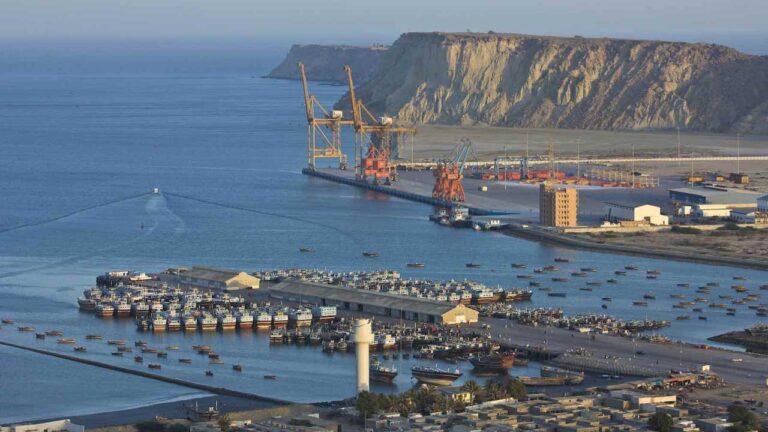
On Saudi Arabia’s northwestern Red Sea coast, a port and industrial zone known as Oxagon is emerging as one of the most tangible components of NEOM.
The project is estimated to involve roughly $20 billion in investment and is built around an unusual concept: a large octagonal industrial platform extending into the Red Sea.
According to the project’s design, the floating structure allows Saudi Arabia to develop deep-water port infrastructure while preserving approximately 95 percent of the natural coastal environment and reducing the need for extensive land reclamation.
The scale of the engineering is substantial.
By November 2025, BESIX had completed more than 4.6 kilometers of quay wall. Seven deep-water berths had also been completed, with depths ranging from 10.5 to 18.5 meters.
These facilities are intended to accommodate some of the largest container ships operating in global trade.
In March 2026, Boskalis completed a major dredging operation to deepen and widen the port’s main access channel. A 900-meter automated container terminal was under construction and expected to open during 2026.
Oxagon’s planned container capacity is approximately 1.5 million TEU. That is relatively modest compared with established regional and global ports. Dubai’s Jebel Ali, for example, has capacity of around 14 million TEU, while Singapore’s Tuas Port is being developed toward a capacity of 65 million TEU.
But Oxagon does not need to match those figures immediately.
It is being built in a location where there was previously no comparable container infrastructure. The port has already begun welcoming international shipping lines and handling cargo associated with NEOM’s construction and early operations.
That makes the central question less about whether the infrastructure can function and more about whether enough companies will use it.
Industrial Tenants Are Beginning to Arrive
One of the strongest arguments for Oxagon is that its development is not based entirely on future projections.
Several major industrial projects are already being developed within the area.
A $5 billion green hydrogen plant, described as the world’s largest, is being developed through a joint venture involving Air Products, ACWA Power, and NEOM.
Gulf Modular International is also developing what is described as the world’s largest modular building factory. The facility is designed to produce 12,500 building units per year.
A large hyperscale data center is also planned for the Oxagon industrial zone through a joint venture between FAS Energy and NEOM.
Together, these projects point toward a broader shift in Saudi Arabia’s approach to NEOM.
Rather than relying exclusively on enormous residential developments and luxury tourism projects, the strategy is increasingly emphasizing industrial production, logistics, green energy, and data infrastructure.
Oxagon fits naturally into that model.
A functioning industrial zone can generate demand for transportation, warehousing, energy, manufacturing, and logistics services even if the population envisioned for The Line never materializes at its original scale.
That distinction could become crucial to NEOM’s future.
Why the Red Sea Matters
Oxagon’s location is central to its entire business case.
The Red Sea is part of one of the world’s most important maritime corridors. More than 10 percent of global trade passes through the broader route connecting Europe and Asia through the Suez Canal, the Red Sea, and the Indian Ocean.
For decades, ships have passed along Saudi Arabia’s western coastline without generating the kind of industrial and commercial activity that Saudi Arabia now wants to capture.
Oxagon is intended to change that.
The strategy is to turn Saudi Arabia from a country situated beside a major trade corridor into a destination within that corridor.
Manufacturers could import raw materials by sea, process them in Saudi Arabia, and then export finished products to international markets. Logistics companies could use the port as part of broader Europe-Asia supply chains, while industrial businesses could benefit from proximity to shipping routes.
The strategy resembles the model that helped transform Dubai’s Jebel Ali into a major Middle Eastern logistics hub.
Jebel Ali combined large-scale port infrastructure with business-friendly zones, reliable infrastructure, and access to international markets. Over time, thousands of companies established operations around the port.
Saudi Arabia is attempting to apply a similar model on its own Red Sea coast.
But there is one major difference: the security environment.
The Red Sea Crisis Creates a Major Risk
The same shipping corridor that gives Oxagon its strategic appeal has also become a source of considerable uncertainty.
Throughout 2023 and 2024, attacks by the Houthis caused hundreds of shipping companies to abandon the Red Sea route. Many vessels were diverted around the Cape of Good Hope, adding significant time and cost to journeys between Europe and Asia.
Insurance premiums increased, while major carriers including Maersk, MSC, and Hapag-Lloyd diverted vessels away from the Suez route for extended periods.
A ceasefire in Gaza produced a temporary reduction in tensions, but the security situation remained unstable.
According to the script’s account, Houthi missile launches against Israel resumed by March 2026. In April 2026, at least seven commercial vessels were reported to have been attacked in the southern Red Sea and Gulf of Aden.
One Greek vessel was reportedly struck by three ballistic missiles and three drone attacks simultaneously. A Chinese-owned tanker was also hit by a missile and caught fire, despite China’s diplomatic relationship with Tehran.
For Oxagon, this creates a fundamental problem.
A port can offer modern terminals, deep-water berths, industrial facilities, and efficient logistics infrastructure, but shipping companies still have to be willing to send their vessels through the surrounding corridor.
If carriers view the Red Sea as too dangerous, Oxagon’s location becomes a liability rather than an advantage.
The $20 Billion Bet
Saudi Arabia has committed an estimated $20 billion to Oxagon. The quay walls have been constructed, dredging has progressed, industrial tenants are establishing facilities, and port operations have begun.
At this stage, the question is no longer simply whether Saudi Arabia will build the port.
Much of it is already there.
The bigger question is whether the economic conditions required to justify such a large investment will develop.
One factor is NEOM itself.
If The Line ultimately becomes a much smaller development, it could generate less manufacturing, population, and consumer demand than originally anticipated. Oxagon therefore needs an economic base that extends beyond the original vision for the futuristic city.
Saudi Arabia’s shift toward industrial and AI-related development could help provide that demand.
But another factor is much harder to control: the Red Sea’s security environment.
Global shipping companies make long-term infrastructure and logistics decisions based on reliability, cost, and risk. Persistent attacks could discourage carriers from treating the Red Sea as a dependable commercial corridor.
This leaves Oxagon facing a challenge that no amount of construction can solve on its own.
A Port Cannot Create Its Own Demand
NEOM’s official vision remains publicly intact, while reports of internal revisions point toward a considerably smaller and more selective development strategy.
The final outcome is still uncertain.
What is already visible, however, is the physical progress at Oxagon.
More than 4.6 kilometers of quay wall have been completed. Seven deep-water berths are in place. A large industrial platform is taking shape in the Red Sea. Green hydrogen production, modular manufacturing, and data-center projects are being developed around the port.
These are tangible assets rather than purely conceptual elements of NEOM’s original vision.
Yet infrastructure alone does not guarantee commercial success.
The history of major ports repeatedly demonstrates the same fundamental principle: a port needs customers, cargo, shipping connections, and surrounding economic activity.
Jebel Ali did not become a major logistics center simply because Dubai built a large port. Its growth was tied to Dubai becoming a place where international companies wanted to establish businesses and move goods.
Oxagon faces the same fundamental test.
Saudi Arabia’s NEOM strategy is changing.
The original vision of a vast futuristic region remains part of the official narrative, but cancelled contracts, reduced construction activity, and reported revisions to The Line indicate that the project is being managed more selectively than initially planned.
At the same time, Oxagon represents a different kind of ambition.
Rather than depending entirely on a futuristic city filled with millions of residents, the port is being built around industrial production, logistics, green hydrogen, manufacturing, and data infrastructure.
Its physical development is already well underway.
Also Read: Why Bhutan is Building its Biggest Airport Next to India
But Oxagon’s ultimate success depends on factors beyond Saudi Arabia’s control. The Red Sea must become sufficiently stable for shipping companies to commit to the corridor, while the surrounding NEOM developments must generate enough economic activity to support the port.
The infrastructure is being built. Industrial tenants are arriving. Cargo operations have begun.
The unresolved question is whether the trade, companies, and long-term demand needed to make Oxagon a major global port will follow.