
Can This Route Really Replace the Strait of Hormuz
A Line on the Map
Look at any global shipping map and you will notice one narrow passage that carries enormous weight. The Strait of Hormuz acts as a pressure point for the entire energy market. Now imagine drawing a line that completely avoids it. That line already exists on paper, and now it is turning into a working system.
The UAE and Saudi Arabia have started activating what many call the Sharjah–Dammam Trade Corridor. Some describe it as a land bridge. It moves cargo around one of the most sensitive chokepoints on Earth without relying on that waterway at all. Ships stop before they reach the Strait, unload on the UAE’s east coast, and shift cargo across land into Saudi Arabia.
At first, this idea feels counterintuitive. Ships dominate global trade for a reason. They move massive volumes at low cost. You might ask why anyone would shift cargo onto trucks and trains when sea routes already exist. The answer becomes clear the moment risk enters the equation. When one narrow stretch of water controls such a large share of global oil and trade flows, every disruption sends shockwaves across markets.
Also Read: The $500BN Megacity That Saudi Arabia Is Scaling Back
I have studied trade corridors and chokepoints for years, but this is one of the few moments where you can actually see a new route challenge an old dependency in real time.
The Problem: A Single Point of Failure
Geography shapes power. The Persian Gulf holds some of the largest oil and gas reserves on the planet, yet almost every export depends on a single exit. The Strait of Hormuz sits between Iran and Oman, and at its narrowest point it measures only about 33 kilometers. That small gap carries nearly 20 percent of the world’s petroleum liquids, according to the U.S. Energy Information Administration.
That concentration creates risk. Any disruption, even a minor one, triggers immediate consequences. Shipping companies slow down operations. Insurance premiums spike. Freight rates climb. Energy markets react within hours.
Recent regional tensions have pushed this risk from theory into reality. Reports from Al Arabiya and The National News in March 2026 highlight how instability has already started to affect shipping confidence and route planning. Even the possibility of disruption forces companies to rethink logistics.
You can build the most advanced ports, cranes, and logistics zones, but if every shipment must pass through one fragile corridor, your entire system inherits that vulnerability. That is the core problem this new corridor tries to solve.
The Idea: Rerouting Before the Risk Begins
Instead of forcing ships through Hormuz, the UAE and Saudi Arabia chose a different approach. They reroute cargo before it even reaches the chokepoint.
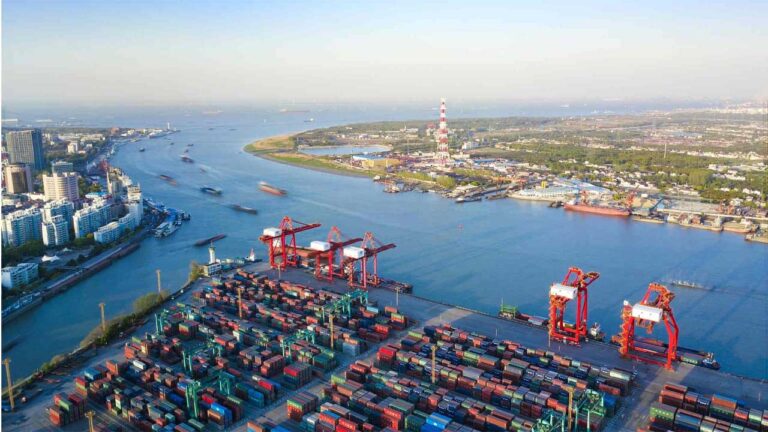
The key lies in geography. Khorfakkan Port sits on the Gulf of Oman, outside the Strait of Hormuz. Ships arriving here avoid the chokepoint entirely. They approach directly from open ocean routes that connect to Asia, Africa, and Europe.
This single advantage changes everything. It allows operators to intercept cargo early, before risk, congestion, or delays build up. Gulftainer, which has operated Khorfakkan since 1986, has steadily expanded the port’s capacity, turning it into one of the most capable container terminals in the region.
Once cargo lands here, the system shifts from sea to land. That shift defines the entire corridor.
How the Corridor Actually Works
After unloading at Khorfakkan, containers move inland to the Sajaa Dry Port in Sharjah. This facility acts as a central logistics hub. It handles customs clearance, storage, sorting, and consolidation. Instead of dealing with congestion at major seaports, operators process cargo in a controlled inland environment.
From Sajaa, cargo moves across the UAE using highways and the growing Etihad Rail network. This railway project connects key industrial zones across all seven emirates and extends toward Saudi Arabia. It forms the backbone of cross-border freight movement.
Cargo then crosses into Saudi Arabia and moves toward Dammam. This city anchors the Kingdom’s Eastern Province, a region filled with heavy industries, oil production facilities, and critical export infrastructure. King Abdulaziz Port in Dammam plays a central role, acting as a major gateway for distribution and international trade.
The flow stays simple and efficient. Ships arrive at Khorfakkan. Cargo moves inland to Sharjah. Rail and road carry it into Saudi Arabia. From there, it either reaches local markets or returns to sea through Gulf ports.
This layered system gives operators flexibility. If one segment slows down, others can adjust. That flexibility matters in a region where disruptions can escalate quickly.
This Is Already Operational
Many people assume this corridor requires massive new construction. That assumption misses the real story.
The infrastructure already exists. Khorfakkan has operated for decades. Sajaa Dry Port has expanded into a major logistics center. UAE highways rank among the best in the region. Etihad Rail continues to grow as a national freight network. Saudi Arabia has already built strong port capacity in Dammam.
What changed is coordination. In March 2026, Saudi Arabia’s Ports Authority and Gulftainer confirmed a formal partnership to activate this corridor. Sources like The National News and TTL Logistics outline how both sides aligned operations to create a unified route.
This shift turns separate assets into one connected system. Instead of waiting years for new megaprojects, operators can start using this corridor almost immediately.
Speed Changes the Equation
Speed often decides which route wins. This corridor offers a clear advantage in certain cases.
A traditional sea route to Saudi Arabia’s east coast forces ships to travel around the Arabian Peninsula and pass through Hormuz. That journey adds time, distance, and risk. By stopping at Khorfakkan, ships cut that path significantly.
Industry estimates suggest time savings of 24 to 48 hours for certain shipments. That reduction may sound small, but it creates major value for time-sensitive cargo. Electronics, automotive parts, and high-value goods depend on precise delivery schedules. A single day can affect entire production lines.
You also gain predictability. Land transport operates within controlled networks. Ports, roads, and railways follow scheduled operations. Sea routes remain exposed to weather, congestion, and geopolitical tension.
Why Everyone Is Not Using It Yet
If this system offers speed and safety, you might expect universal adoption. That has not happened, and there are clear reasons.
First, capacity limits the system. Khorfakkan and Sajaa handle large volumes, but they cannot absorb the full scale of Gulf trade. The Strait of Hormuz carries millions of barrels of oil every day. No land corridor can match that volume.
Second, cost plays a role. Sea transport remains cheaper for bulk cargo. Moving containers by truck and rail adds handling steps and operational expenses. Companies must weigh speed against cost.
Third, logistics add complexity. Cross-border transport requires customs coordination, documentation, and regulatory alignment. Even small inefficiencies can slow down operations.
Fourth, environmental impact raises questions. Large container ships move goods efficiently with lower emissions per unit. Land transport can increase emissions if not managed carefully, especially with heavy truck usage.
What This Corridor Really Changes
This corridor does not replace the Strait of Hormuz. It reduces dependence on it.
That distinction matters. Global trade no longer relies on single routes. Countries now build multiple pathways to protect supply chains. The Suez Canal, Panama Canal, and Strait of Malacca all face similar pressures. Each chokepoint pushes nations to develop alternatives.
The UAE and Saudi Arabia understand this shift. Both countries aim to position themselves as global logistics hubs under strategies like Saudi Vision 2030 and the UAE’s long-term economic plans. Reliable trade routes strengthen that position.
This corridor adds resilience. It gives operators a second option when risk increases. It allows faster response during disruptions. It creates competition between routes, which can improve efficiency over time.
Also Read: Why Bhutan is Building its Biggest Airport Next to India
The Final Reality
So can this route replace the Strait of Hormuz. No. It does something more practical. It gives the region breathing space. It reduces pressure on a single chokepoint. It creates flexibility where none existed before.
You should not see it as a replacement. You should see it as insurance. And in a world where one incident can disrupt global trade within hours, having that backup may matter more than any megaproject ever built.