
The $15 Billion Channel Tunnel That Connected Britain to Europe
The Handshake Beneath the Sea
On December 1, 1990, two engineers reached toward each other through a narrow opening carved deep under the English Channel. They stood nearly 45 meters below the seabed, surrounded by darkness, rock, and the constant pressure of the sea above them. When their hands met, it marked more than a construction milestone. It marked the moment Britain physically reconnected with mainland Europe for the first time in almost 8,000 years, since rising sea levels had separated the landmass after the last Ice Age.
I still picture that moment as if I were standing in that tunnel, hearing the machines fall silent as history quietly changed course beneath the sea.
That single handshake came at the end of a long and uncertain journey. The Channel Tunnel, often called the Chunnel, cost close to $15 billion, pushed engineering limits, and faced repeated financial and technical threats. Many experts once dismissed the idea as impossible. Today, it stands as one of the most important transport links in the world, and in 2026, it continues to evolve with new technology that strengthens its role in Europe’s transport network.
Also Read: Why Ethiopia is Risking $12.5 Billion on One Airport
A Vision That Struggled for Over a Century
The idea of linking Britain and France through a fixed crossing dates back to the early 19th century. Engineers and visionaries proposed ambitious designs, ranging from tunnels for horse-drawn carriages lit by oil lamps to massive bridges supported by artificial islands. These concepts showed imagination, but they lacked the technical foundation needed to turn vision into reality.
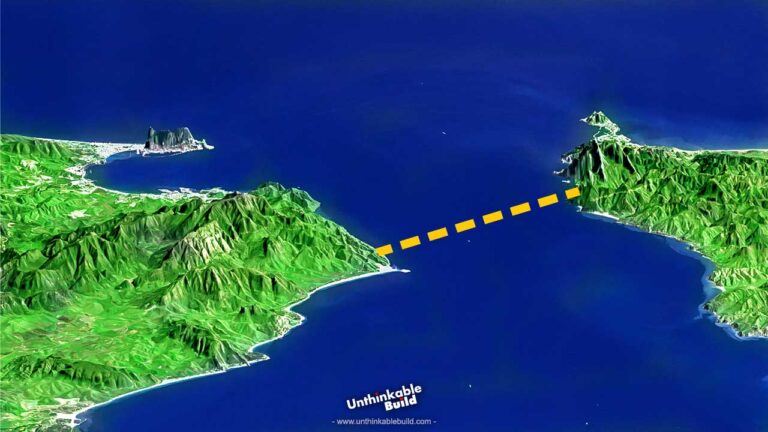
The English Channel presented extreme challenges. It carries one of the busiest shipping lanes in the world, with hundreds of vessels passing daily. Strong currents, deep water, and unpredictable geology made construction risky. Early geological surveys failed to provide clear data about the seabed, which increased uncertainty.
Political concerns also slowed progress. British leaders feared that a direct land connection could weaken national security by making invasion easier. Several proposals gained attention but collapsed due to cost concerns, political resistance, or engineering doubts.
By the late 20th century, economic pressure began to shift the conversation. Trade between the United Kingdom and mainland Europe grew rapidly. Ferries and air transport struggled to keep up with demand. Businesses needed faster and more reliable routes. Governments in both countries agreed on one condition that shaped the entire project. They would not fund it with public money. Private investors would carry the financial burden.
This decision turned the Channel Tunnel into one of the largest privately financed infrastructure projects in history. It raised the stakes and added pressure at every stage.
Designing a Tunnel That Could Survive the Sea
Eurotunnel, the company selected to build and operate the project, proposed a design that balanced safety, efficiency, and long-term durability. Engineers did not plan a single tunnel. They designed a three-tunnel system.
Two large rail tunnels would carry trains in opposite directions. Between them, a smaller service tunnel would run parallel. This central tunnel would serve as a safety corridor, allowing maintenance crews to access the system and providing a protected escape route during emergencies. It would also support ventilation and pressure control, which are critical in a confined underground environment.
The next challenge involved choosing the right geological path. After years of surveys and test drilling, engineers selected a layer known as Chalk Marl. This rock sits around 40 meters beneath the seabed. It offers a rare combination of properties. It is soft enough for machines to cut through efficiently, yet strong enough to maintain structural stability. It also resists water penetration, which is essential under the sea.
If the tunnel drifted outside this layer, it could encounter fractured rock or water-bearing sand. That scenario could lead to flooding, which would put workers and the entire project at risk. Engineers had no room for error.
The Machines That Made the Impossible Real
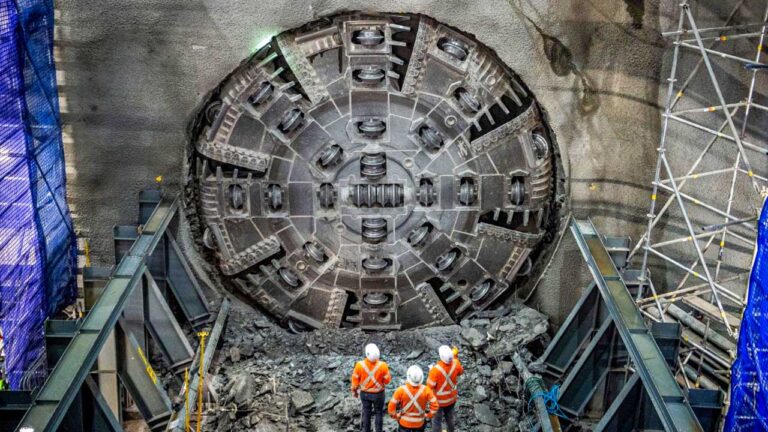
Construction began in 1988, and engineers deployed 11 massive tunnel boring machines. Each machine weighed about 1,100 tons and stretched longer than two football fields. These machines operated like underground factories. They cut through rock at the front and installed concrete lining segments at the rear, creating a finished tunnel as they advanced.
Each concrete ring locked into place with precision. Workers installed more than 750,000 segments throughout the project. These segments were designed for durability, with a lifespan of at least 120 years. They formed a watertight barrier that protects the tunnel from the surrounding sea.
Excavation created another challenge. Engineers removed millions of cubic meters of material from beneath the Channel. Instead of discarding it, they used it to reshape the coastline. In England, they deposited much of the excavated chalk at the base of the White Cliffs of Dover, creating a new 90-acre area known as Samphire Hoe. This land now supports wildlife and public access, turning construction waste into a lasting environmental asset.
When tunneling finished, engineers faced a practical problem. The tunnel boring machines were too large to remove. Instead of dismantling them, they drove several machines deeper into the ground and sealed them in place with concrete. Those machines remain buried beneath the seabed, hidden but still part of the tunnel’s story.
The Moment Accuracy Became Everything
The most critical phase came when British and French teams worked toward each other from opposite sides of the Channel. The British team started near Dover at Shakespeare Cliff. The French team began near Calais at Sangatte. Both teams drilled through solid rock with no direct visual contact.
Even a small miscalculation could have caused the tunnels to miss each other. Engineers relied on advanced surveying techniques, including laser guidance systems and precise geodetic measurements linked to satellite data. These systems allowed teams to maintain alignment over long distances underground.
After years of drilling, the breakthrough moment arrived. When engineers measured the alignment, they found a deviation of only 35 centimeters. This level of precision, achieved beneath the sea from two separate countries, demonstrated extraordinary engineering control. It proved that the doubts surrounding the project no longer applied.
From Engineering Marvel to Smart Infrastructure
The Channel Tunnel opened in 1994, linking Folkestone in the UK with Coquelles near Calais in France. It quickly became a key route for passenger and freight transport. High-speed Eurostar trains reduced travel time between London and Paris to just over two hours. Shuttle services carried cars, trucks, and buses through the tunnel, creating a continuous flow of movement between the two regions.
In 2026, the tunnel continues to evolve. Operators are upgrading systems to increase capacity and improve reliability. One major upgrade involves the European Rail Traffic Management System. This signaling system allows trains to run closer together without compromising safety. It increases throughput and reduces delays, which benefits both passengers and freight operators.
Engineers are also strengthening the electrical infrastructure. New systems such as Static Synchronous Compensators stabilize voltage and improve power quality. This ensures that high-speed trains operate smoothly under varying loads.
The tunnel now plays a role in reducing transport emissions. Pilot programs launched in 2026 focus on electric freight movement. These programs test how electric heavy goods vehicles can integrate with rail logistics, creating a lower-emission corridor between the UK and mainland Europe. Logistics hubs, including facilities in East London, support this shift by improving cargo handling and distribution.
A Lasting Legacy Beneath the Water
The Channel Tunnel stretches 50.4 kilometers, with 37.9 kilometers running under the sea. It remains the longest undersea rail tunnel section in the world. It stands as a symbol of persistence, technical skill, and cross-border cooperation.
Financial performance has improved after early struggles. Getlink, the current operator, reported strong earnings in recent years and continues to invest in upgrades. Plans for new direct rail routes aim to connect London with cities such as Cologne, Geneva, and Milan. Rail operators across Europe are preparing to expand services, which will increase the tunnel’s strategic value.
Also Read: What Really Happens to Aluminum Cans in the United States
The Channel Tunnel changed how people think about distance and connection. It removed a natural barrier that had defined Britain’s identity for thousands of years. Engineers proved that determination and precision can overcome even the most daunting natural obstacles.
You can travel from London to Paris without ever seeing the sea above you, yet you move through one of the most complex engineering systems ever built. I see this tunnel not just as infrastructure, but as a quiet reminder that some of the most powerful connections are built out of sight, deep beneath the surface.