
Australia’s Inland Rail: Inside the Thirty One Billion Dollar Bet Reshaping a Continent
Australia is building one of the largest and most ambitious infrastructure projects in its history. A freight rail corridor stretching nearly seventeen hundred kilometres through the interior, designed to shift the nation’s logistics backbone away from congested highways and outdated coastal rail. Known as Inland Rail, this project was once promoted as a fast and efficient solution to a mounting freight crisis. Today, it has become a thirty one billion dollar mega challenge that raises urgent questions about national planning, engineering oversight, and the risks governments take when they commit to building at scale. I remember standing near an early construction zone in New South Wales and feeling the sheer scale of earthworks that hinted at a future still years away.
Why Freight Shapes Australia’s Future
Australia’s geography creates a supply chain unlike any other developed nation. Most Australians live along the eastern and southern coasts, yet food, minerals, manufactured goods, and consumer imports travel vast distances to reach distribution hubs. The ports of Melbourne, Sydney, and Brisbane form the beating heart of this network, feeding into corridors that often stretch hundreds of kilometres inland.
Demand keeps rising. Data from the CSIRO and federal freight strategy forecasts shows east coast freight loads could reach eight billion tonnes by 2030. This surge pushes a system already close to breaking point. Every supermarket shelf, medical shipment, construction supply run, and retail delivery depends on corridors that struggle to keep pace with population growth and economic expansion.
You can feel the pressure building across the entire network. It is clear that without decisive upgrades, supply chain delays and rising delivery costs will only intensify.
Also Read: Inside Bhutan’s $10B Gelephu Mindfulness City: The World’s Most Unusual Urban Experiment
A Road Network Under Strain
Road freight currently carries roughly three quarters of all goods moved between Melbourne and Brisbane. That dominance comes at a high cost. Major interstate routes such as the Hume, Newell, and Pacific Highways now operate far beyond their intended capacity. Long rows of B double combinations and heavy road trains grind through cities, regional towns, and critical freight links every hour of the day.
This creates three serious challenges.
First, safety. Heavy vehicle crashes continue to represent a disproportionate share of serious road incidents. The presence of multiple large trucks on narrow or aging regional corridors puts pressure on both freight operators and private motorists.
Second, congestion. Freight trucks push deep into metropolitan areas to reach ports and industrial precincts. Each delay increases the cost of last mile delivery, compounding the impact on consumers and businesses.
Third, road damage. A single heavy truck can impose the same wear as hundreds of thousands of cars. State and local governments face soaring maintenance budgets as pavement failures, bridge fatigue, and shoulder erosion accelerate across key routes.
The simple truth is that Australia cannot continue to rely so heavily on road freight. A shift toward a faster, more reliable rail alternative is essential for economic stability.
Why Existing Rail Could Not Compete
Australia’s coastal rail network evolved in an era when freight volumes were lower and freight trains were shorter. The Melbourne to Brisbane route winds through multiple population centres and must share track with passenger services. In Sydney, strict curfews force freight movements into limited windows outside commuter peaks. Slow speeds, steep gradients, and tight curves further reduce efficiency.
A freight journey between Melbourne and Brisbane can take more than thirty two hours. That figure is not competitive with modern long haul trucking. Trains lose valuable time passing through bottleneck after bottleneck, particularly near Sydney, where passenger demand always takes priority.
As rail became slower and less predictable, operators shifted to road because it offered certainty. Inland Rail emerged as the first credible plan with the potential to reverse that shift.
A Vision More Than One Hundred Years Old
The idea of an inland freight route has deep roots. Early proposals surfaced as far back as 1915 when planners recognised the strategic value of a direct corridor through the interior. War, economic constraints, and political turnover repeatedly stalled the idea.
The rise of containerisation and soaring freight loads in the late twentieth century brought renewed interest. By the early 2000s, conversations around a direct Melbourne to Brisbane rail spine gained strength. The turning point came in 2015 when a detailed feasibility study confirmed that a new inland corridor could dramatically cut journey times and reduce the load on Australia’s highways.
In 2017, the federal government committed an initial 8.4 billion dollars to deliver the project. That moment shifted Inland Rail from a long standing aspiration to an approved national undertaking.
What Inland Rail Actually Builds
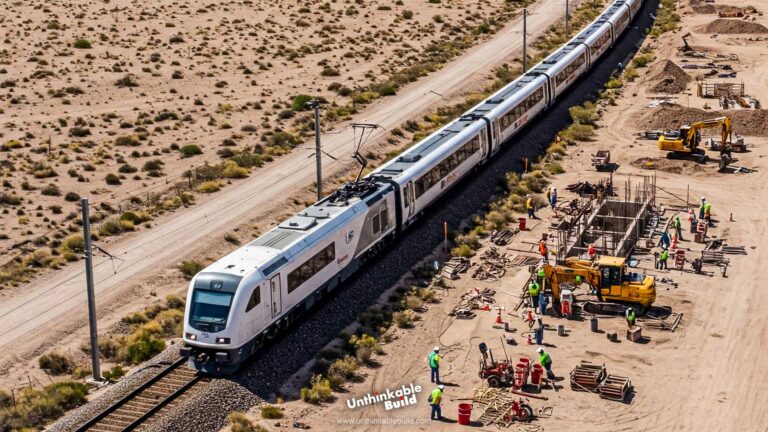
Inland Rail is a purpose built freight corridor engineered for speed, volume, and reliability. The full length measures around seventeen hundred kilometres and comprises thirteen individual sections across Victoria, New South Wales, and Queensland.
The design supports trains up to one point eight kilometres long. These trains can carry double stacked containers, which increases capacity and reduces the number of trains needed to move the same amount of freight. The corridor also avoids the congested metropolitan region of Sydney, giving freight operators a fully dedicated route free from suburban passenger interference.
Roughly six hundred kilometres of the route is entirely new construction through farmland, plains, and several major floodplains. The remaining eleven hundred kilometres require extensive upgrades to existing track, including new bridges, passing loops, tunnels, and increased clearance for double stacking.
The first completed section, Parkes to Narromine, opened in 2020 and demonstrated how new track geometry could improve speed and reliability across regional corridors.
The Performance Impact and Regional Reach
Inland Rail aims to deliver a Melbourne to Brisbane freight journey in less than twenty four hours. That performance target directly challenges long haul trucking and represents a shift toward a more resilient freight network.
The project also strengthens regional economies. Parkes, Moree, and Toowoomba have been identified as major logistics hubs, attracting warehousing, intermodal terminals, and agribusiness processing. The Queensland section links into the Toowoomba Second Range Crossing and the Port of Brisbane freight networks, offering farmers faster export pathways.
Government modelling suggests the project could deliver around sixteen billion dollars in economic benefits over fifty years and create roughly sixteen thousand jobs during the construction phase. That impact spreads across multiple industries, including steel fabrication, quarry supply, rail operations, and civil engineering.
Regional communities have already seen early signs of investment as land values shift and logistics companies prepare for future terminals.
The Escalating Problems and the Mounting Scrutiny
Despite its expected benefits, Inland Rail has faced significant turbulence. The most contentious issue is cost. An independent review in 2023 revealed that the estimated cost had risen from the original 8.4 billion dollar commitment to more than thirty one billion dollars. This increase was described as one of the largest cost escalations in the history of Australian infrastructure.
Multiple factors contributed to this rise. Designs were incomplete when funding was approved. Land acquisition became more expensive than expected. Global supply chain disruptions, construction labour shortages, inflation, and extended approval timelines added pressure. Several sections of the route required redesign after community feedback, particularly near environmentally sensitive areas.
The timeline has also slipped by several years. Most of the corridor will not be finished until around 2030 or 2031. Current planning prioritises delivery of the southern section from Melbourne to Parkes, with construction efforts concentrated there until at least 2027.
Community resistance remains strong across parts of Queensland and New South Wales. Farmers worry that embankments across the Condamine and Macintyre floodplains could redirect water during major flood events. Indigenous groups continue to raise concerns about cultural heritage protection. The review also found gaps in governance, prompting the government to restructure oversight and require stronger engineering and financial controls within the project team.
Also Read:The $500M Skyscraper Meta Abandoned | San Francisco’s Ghost Tower
The Country Now Faces a Defining Choice
Inland Rail stands at a critical point. Several sections are built. Billions have already been spent. The national freight task continues to grow. The need for a competitive rail corridor remains undeniable.
Yet questions linger. Can the project deliver its promised economic and operational gains within the new budget forecast. Can regional communities trust that flood risks and cultural concerns will be managed responsibly. Can Australia complete a mega project of this scale without repeating the errors that triggered the cost surge.
The project reveals the difficulty of building modern infrastructure across a continent shaped by extreme weather, complex land ownership, and rising construction costs. It also reveals how fragile public trust becomes when budgets spiral.
The vision stays clear. Australia wants safer roads, faster freight, and a more resilient economy. Whether thirty one billion dollars becomes a wise national investment or a costly lesson in planning will depend on the final delivery of a project that continues to shape the future of the country.