Dubai’s 35 Billion Dollar Mega Airport That Will Redefine Global Air Travel
Across the southern edge of Dubai, the desert stretches into a pale horizon where heat shimmers above the sand. For years, this land sat untouched except for a few runways carved into the ground. Construction paused, machines were parked in silence, and the world moved on. That silence is gone now. Crews have returned, cranes loom over the landscape, and the foundations of a global aviation shift rise again. Here, Dubai is building Al Maktoum International Airport, a 35 billion dollar megaproject designed to handle up to 260 million passengers each year. No airport in history has ever attempted capacity at this scale. You sense the ambition the moment you step onto the site; the desert feels like it’s being reshaped in real time.
Dubai’s Urgent Need for a New Global Gateway
Dubai International Airport, better known as DXB, has dominated international aviation for more than a decade. With nearly 92 million passengers a year, it functions as the crossroads of Europe, Asia, and Africa. You can feel the pressure inside the terminals, where every available expansion has already been used. DXB is locked inside dense neighborhoods and major highways, creating a physical barrier to future growth. Engineers have stretched every possibility, from new concourses to expanded taxiways, but the airport simply cannot scale any further.
Aviation powers more than a quarter of Dubai’s economy. It drives tourism, supports trade, and fuels the global identity of the city. Dubai knows its competitive edge depends on staying one step ahead of emerging hubs. Standing still would erode its influence. So leaders chose a path that few nations could commit to. Instead of forcing more expansion into a saturated site, they moved into the desert and planned an entirely new air city from scratch. It’s a decision rooted in confidence and the understanding that global travel demand will keep rising across the Middle East and Asia.
Also Read: Inside Kuwait’s $4.3 Billion Futuristic Airport That’s Redefining Air Travel
The Vision Behind Al Maktoum International Airport
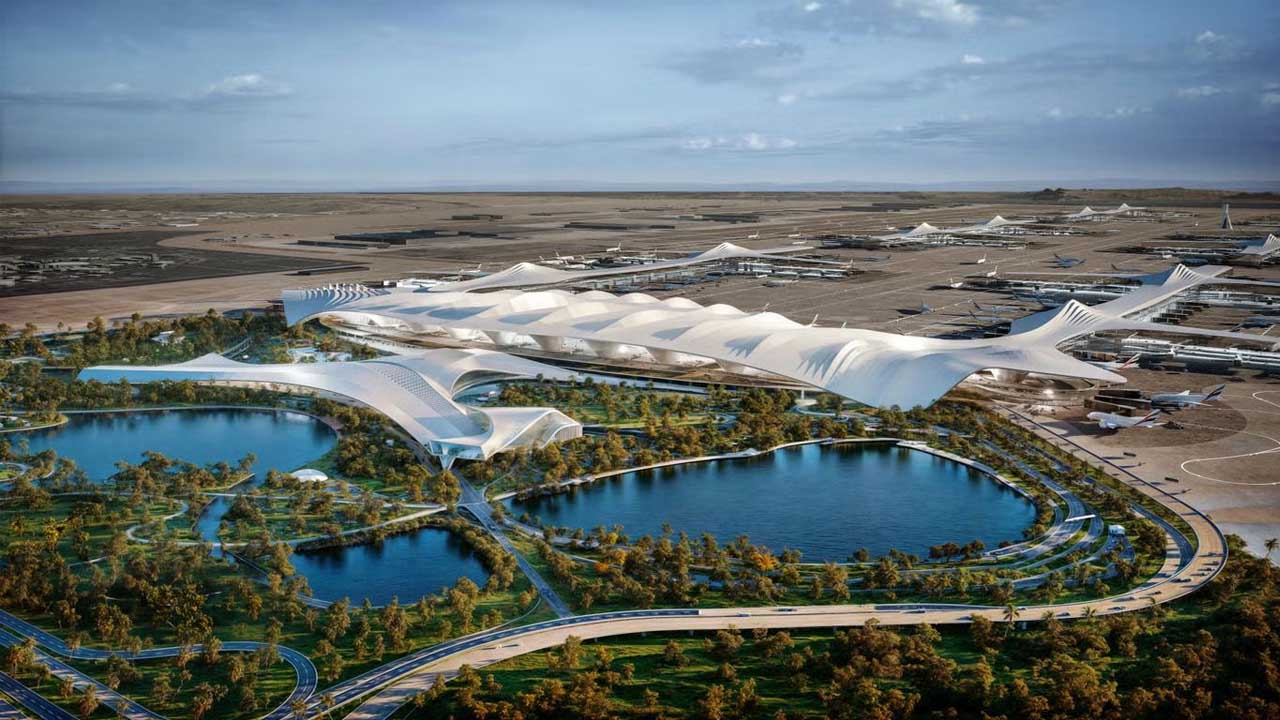
About 40 kilometers southwest of downtown Dubai, near Jebel Ali Port, sits the massive footprint of Al Maktoum International Airport. The scale surprises you even when you expect it. The airport covers roughly 70 square kilometers, nearly twice the size of Manhattan. The master plan includes five parallel runways long enough for the largest intercontinental aircraft, more than 400 aircraft gates, and the ability to process over twelve million tonnes of cargo each year.
Architecture firm Coop Himmelb(l)au shaped the design of the terminals. They envisioned flowing steel structures, soaring internal canopies, and open-air concourses softened by water features and shaded gardens. The intention is to redefine the passenger experience, turning long-haul travel into something calmer and more humane. Trees, natural ventilation systems, and daylight-driven interiors will replace the enclosed, stressful feel of traditional hubs. You sense Dubai wants passengers to feel like they entered a city the moment they land.
Dubai’s leaders have insisted that the airport must serve as a visual declaration of the city’s global role. This is not a gateway built only for function. It reflects the confidence of a region pushing toward new economic heights.
A Strategy Shaped Around a New Kind of City
Al Maktoum International is not merely an airport. It’s the core of Dubai South, a new district planned to house more than one million residents. Homes, offices, logistics zones, and research hubs will operate in sync with aviation at their center. The idea is simple: create a region where people can live close to the world’s largest air hub, reducing commute times and strengthening business networks.
The location ties directly into Dubai’s most powerful economic engines. It sits beside Jebel Ali Port, a port that moves over 15 million containers a year and remains one of the busiest in the world. Next to the port sits Jebel Ali Free Zone, home to thousands of international companies. And soon, Etihad Rail will connect the airport to Abu Dhabi, Sharjah, and major industrial regions across the UAE. Cargo could transfer between ship, aircraft, and rail in a single day. Few cities have such alignment, and Dubai intends to use this advantage to strengthen its role in global trade.
This isn’t just about building a bigger airport. It’s about creating an economic ecosystem where aviation, logistics, technology, and real estate fuel each other. You can see why Dubai calls this project a new gateway for the world.
The Long Road to Construction
Work on the airport began in 2007, a period when Dubai seemed unstoppable. Then the financial crisis struck, and progress stalled. The site sat partially built for years, with occasional upgrades but no meaningful momentum. Now the city has revived the project with a clear timeline. Phase one aims for completion by 2032, giving the airport the capacity to serve 150 million passengers annually.
A contract worth more than one billion dirhams has already been issued for a major runway upgrade. New concourses and supporting infrastructure are under construction. Dubai plans a phased transition. Cargo operations, maintenance, and low-cost carriers will move first. By the mid-2030s, Emirates Airlines is expected to relocate its entire operation to the new airport. DXB will remain active but shift toward business travel and regional flights, ensuring smooth continuity for travelers and airlines.
The move will reshape the city’s flow of people, commerce, and real estate. You see the shift already as new roads and utilities expand deep into the desert.
A Region in Fierce Competition
The Middle East has become a battleground for global aviation. Cities across the region are investing heavily in mega-airports as tools of economic influence. Saudi Arabia is developing King Salman International Airport in Riyadh with a target of 185 million passengers. Qatar continues to expand Hamad International. Istanbul’s airport has become Europe’s busiest only a few years after opening.
Dubai recognizes this competition. It knows that if it wants to remain the world’s aviation capital, it must offer scale, performance, and passenger comfort unmatched by any rival. Al Maktoum International is the city’s answer. Rather than react to regional growth, Dubai intends to set the standard that others must meet. Airports in this part of the world are more than transit hubs. They shape international partnerships and control the flow of global travelers. Dubai’s leaders clearly understand that whoever builds the strongest hub shapes tomorrow’s air routes.
The Economic Logic Behind the Megaproject
Aviation already supports more than a million jobs in Dubai. It contributes heavily to the city’s GDP, and each new airline route drives new markets, tourism, and spending. Building a larger airport increases those opportunities. Yet the economic value extends far beyond passenger numbers.
Land around the airport will become logistics districts, manufacturing clusters, and new residential zones. Dubai will effectively create multiple new communities anchored by the airport’s presence. This model turns infrastructure into development potential. The land value unlocked through this expansion may eventually surpass even the cost of the airport itself.
For a city that grew by turning desert into opportunity, this strategy is familiar. You see how infrastructure can spark entire new economies when placed at the right intersection of mobility and trade.
The Challenges Dubai Must Overcome
A mega-airport in a desert climate brings enormous engineering demands. Cooling alone requires vast power. Water use and energy consumption must be controlled to meet sustainability goals. Dubai is working on energy recycling systems, advanced insulation, and climate-responsive design, yet this remains one of the most complex challenges of the entire project.
Another factor is uncertainty in global aviation. Markets shift. Fuel prices change. Geopolitical tensions affect travel patterns. Dubai is betting confidently on long-term growth, and its track record gives weight to that belief. You can see how past risks paid off, from building Palm Jumeirah to launching Emirates at a time when few believed in the model. Ambition remains at the center of Dubai’s identity.
Also Read: How China’s $1 Trillion Belt and Road Dream Collapsed
A New City Taking Shape in the Desert
If you stand near the site today, the future becomes visible. Runways stretch across the desert like clean lines drawn on a canvas. New terminals rise floor by floor. Roads and utilities trace out neighborhoods that do not yet exist but soon will. The scale feels almost unreal. You understand why experts call this one of the most ambitious airport projects in modern history.
Once Emirates shifts its operations in the mid-2030s, Al Maktoum International will become Dubai’s primary gateway. Its capacity will eclipse every other airport worldwide. Yet the story isn’t about numbers alone. Dubai is reshaping how airports fit into cities, merging identity, infrastructure, and economic planning into one coherent vision.
The airport is not being built beside a city. The airport is the city.
Looking Ahead
Dubai has already proven it can build the world’s busiest airport. Now it aims to build the future of global aviation. When other cities run out of space, Dubai expands into the desert. When others pause, Dubai accelerates. As air travel evolves, this megaproject signals Dubai’s readiness to lead the next era.
You walk across the site and feel the momentum. The desert is no longer empty. It’s becoming the center of global movement.