The World’s Tallest Abandoned Skyscraper That Refused to Disappear
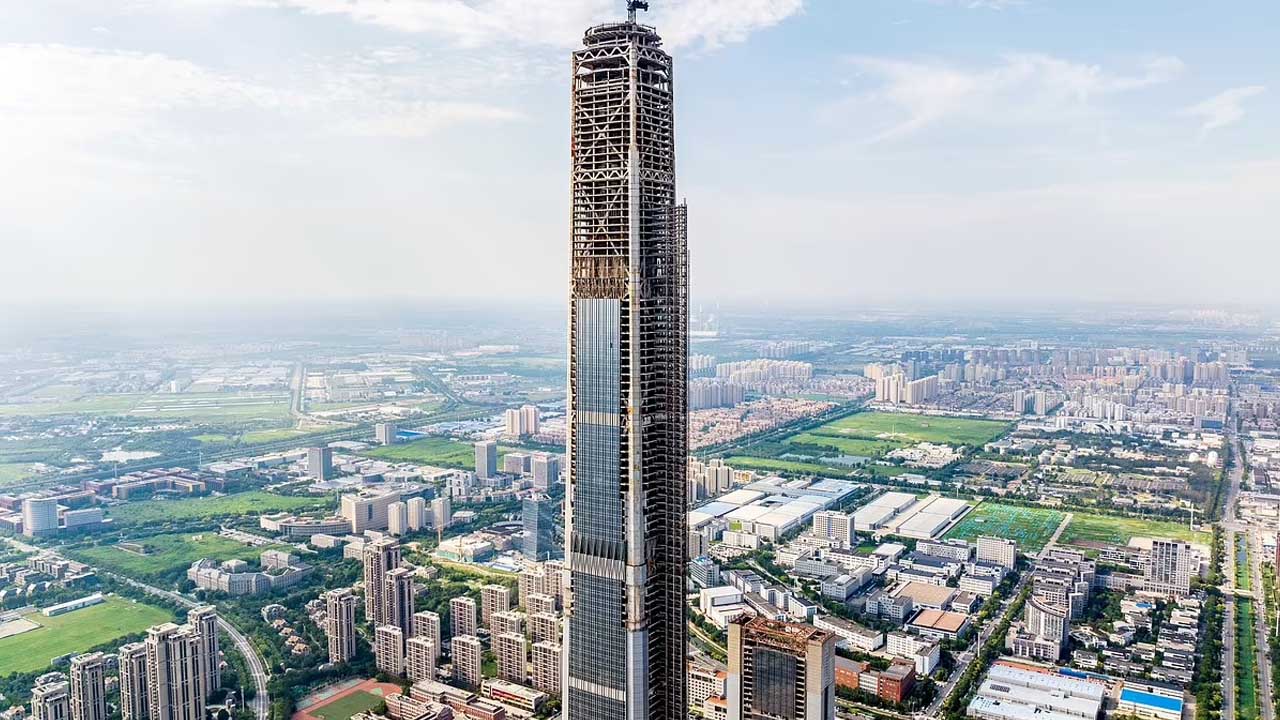
Goldin Finance 117 rises above Tianjin like a frozen promise. At 597 meters tall, this single tower stretches higher than the Petronas Towers, rises beyond the Shanghai World Financial Center, and ranks among the six tallest skyscrapers ever built. You can spot it from kilometers away, a pale concrete spine breaking the skyline without a single completed interior space behind its glassless frame. For nearly a decade, the world knew it as the tallest abandoned skyscraper on Earth. I stood beneath its shadow during research for this story and felt the contradiction firsthand. Here was a structure born to express triumph, yet trapped in a state of silent failure that you could almost hear pressing against the sky.
Tianjin’s Ascent and the Birth of a Global Landmark
The roots of Goldin Finance 117 trace back to the early 2000s, when China experienced the largest migration in modern history. Hundreds of millions left rural homes and moved into rapidly expanding cities. Tianjin became one of the main beneficiaries of that surge. Located just 120 kilometers from Beijing and linked by high-speed rail, Tianjin positioned itself as a financial and industrial gateway to northern China. New ports expanded along the Bohai Rim. Tech parks and manufacturing centers reshaped the skyline. Property values surged. Developers rushed to leave their mark.
Pan Sutong saw this moment as his opportunity. After building wealth through electronics manufacturing and luxury real estate in Hong Kong and mainland China, Pan launched the Goldin Metropolitan project in 2008. The plan aimed to create a luxury district larger than many small cities. The development budget exceeded ten billion dollars and promised villas, a polo club, international schools, vineyards, parks, and high-end retail. At the center stood one object that would capture global attention: Goldin Finance 117, designed as the tallest symbol of Tianjin’s future ambitions.
The tower design called for 128 floors with premium office space, a six-star luxury hotel, sky lobbies, conference venues, and a diamond-shaped crown housing an observation deck intended to rival any in Asia. Developers marketed the structure not only as workspace or hospitality. They sold it as proof of Tianjin’s arrival among global metropolitan elites.
Also Read: The World’s Tallest Dam: Inside Tajikistan’s $6 Billion Megaproject
Engineering a 597-Meter Colossus
Constructing a building that nearly touches 600 meters requires precision that borders on obsession. Engineers designed Goldin Finance 117 with a reinforced concrete core that runs continuously from foundation to crown. Massive steel mega-columns surround the core and connect through an outrigger and belt truss system. This setup anchors the tower while distributing lateral forces produced by extreme wind loads.
The ground beneath Tianjin posed serious challenges. Much of the coastal soil remains soft and waterlogged. To stabilize the foundation, workers drilled deep piles into bedrock, locking the load-bearing base directly into solid geological layers. Without this step, the tower could never have supported its own weight.
Wind engineering dominated the design process. Air velocity at nearly 600 meters creates extreme lateral stress. Engineers tested scaled models in wind tunnels to shape the exterior profile in ways that reduced vortex shedding and oscillation. By subtly tapering the tower and smoothing vertical edges, designers controlled how air moves around the structure.
More than 80 high-speed elevators formed part of the vertical circulation plan, programmed to reach speeds approaching 36 kilometers per hour. These lifts aimed to reduce travel time between ground level and sky lobbies located near the crown. Advanced damping systems and torsional stabilizers further limited structural sway.
At its peak construction phase, Goldin Finance 117 rivaled the Burj Khalifa and Shanghai Tower in engineering complexity. Nothing in the physical design predicted failure.
The Financial Collapse Beneath the Skyline
The project did not fall apart because of flawed engineering. It collapsed because of financial overreach.
Pan Sutong financed much of the development personally. This approach allowed for rapid decision-making but placed enormous risk on a single balance sheet. In 2015, China’s stock market plunged in one of the sharpest single-year declines in its history. Billions disappeared across investor portfolios, including Pan’s own holdings.
The shock compounded after the Tianjin port explosions later that year. One of the largest industrial disasters on record rocked local logistics and investment confidence. Insurance losses surged. Property markets across Tianjin stalled as new development approvals slowed. Property sales weakened.
Pan’s real estate arm, Goldin Properties Holdings, incurred escalating debt with shrinking revenue. His personal fortune fell by an estimated thirteen billion dollars within months. By December 2015, construction financing evaporated entirely. Labor crews left the site. Cranes stopped moving. Interior buildouts never started.
Goldin Finance 117 remained at full structural height but stood empty inside. No curtain wall installed. No elevators fitted. No HVAC systems placed. Nothing beyond raw concrete and steel.
Locals began calling it Tianjin’s ghost tower.
A Monument to Excess
Its shape became impossible to ignore. Residents nicknamed the structure “the walking stick” due to its tall thin shaft topped with the distinctive diamond crown. Tour buses passed by slowly. Drone pilots captured footage that spread across social media. What should have symbolized achievement now reflected stalled ambition.
The tower became shorthand for China’s aggressive real estate expansion during the early 2010s. Cities nationwide raced to erect supertall skyscrapers without matching long-term demand. Vacancy rates climbed. Loan defaults rose. Several developers collapsed under similar debt burdens.
In Tianjin, Goldin Finance 117 embodied both pride and discomfort. The skyline gained global visibility but at the cost of hosting an unfinished relic of excess. For almost ten years, no construction resumed. Rain and coastal humidity stained exposed surfaces. Maintenance crews only secured safety fencing.
The tower appeared destined to remain a permanent reminder of economic imbalance.
Construction Returns in 2025
May 2025 changed the narrative. Heavy equipment reappeared at the site. Contractors fenced off new work zones. Structural engineers returned for assessments. After a decade of dormancy, activity resumed.
The new management structure placed P&T Group from Hong Kong in charge of architectural redevelopment. BGI Engineering, one of China’s major state-linked contractors, assumed responsibility for structural rehabilitation and finishing operations. Reports from Chinese construction agencies indicated backing from government financial instruments intended to stabilize major stalled properties.
The target completion date shifted to 2027.
The restart did not mean simply continuing where construction had halted. Engineers conducted comprehensive forensic reviews on every structural member. Teams performed ultrasonic concrete testing, corrosion analysis on steel anchors, and load redistribution modeling to certify the structure met updated safety standards.
All mechanical, electrical, plumbing, elevator, and fire life systems required full modernization to comply with current codes. Designs originally drafted in the early 2010s no longer aligned with post-pandemic utilization trends.
Developers introduced plans to reconfigure some upper floors for residential use alongside hotel and office space. Market studies suggested that mixed-use occupancy would stabilize revenue better than hotel and office tenancy alone.
Why Revive the Ghost Tower Now?
China’s property sector remains cautious after nationwide debt failures involving major developers from 2021 onward. Cities restricted excess supertall approvals. Financing institutions tightened lending requirements.
Completing existing landmarks proved more economically viable than authorizing new mega projects. Goldin Finance 117 carries global recognition even in its unfinished state. Completing it generates property revenue, boosts city brand value, and demonstrates long-term development credibility.
Image also plays a role. Leaving the world’s tallest abandoned skyscraper unfinished would reflect poorly on Tianjin’s urban administration and China’s broader development narrative. Completion transforms embarrassment into recovery.
International tourism strategies align with this approach. Completed observation decks, luxury hotels, and skyline attractions generate high-margin tourism flows. Tianjin aims to reassert itself as a northern commercial hub that complements Beijing rather than competes against it.
Technical Challenges Ahead
Finishing a ten-year dormant skyscraper presents complications that new construction never encounters.
Material degradation forces partial replacement of reinforcement zones. Mechanical shafts must adapt to newer efficiency regulations. Energy consumption targets now require high-performance glazing systems, geothermal support, and advanced airflow automation.
Structural fatigue assessments remain ongoing due to prolonged wind exposure without tuned damping devices. Engineers continue microscopic crack mapping to guarantee structural continuity across load-bearing joints.
Also Read: Inside the Collapse of China’s New Silk Road in Europe
Supply chain recalibration adds complexity as specialized elevator components, fire suppression systems, and glass curtain wall panels require international sourcing amid stricter import controls.
Each stage proceeds cautiously, with safety audits preceding every reactivation phase.
A Story of Collapse and Recovery
Goldin Finance 117 tells a uniquely human story of ambition and financial vulnerability. It rose from optimism, stalled through miscalculation, and now re-emerges during a period of painful recalibration within China’s property sector.
The tower reflects both the bold confidence that fueled two decades of urbanization and the sobering realities that followed unchecked expansion. I find its revival compelling because it mirrors cycles you recognize everywhere. Growth lifts projects skyward. Misjudgment freezes momentum. Recovery arrives slowly through discipline and adaptation.
By 2027, if timelines hold, Goldin Finance 117 will finally introduce visitors to one of the highest observation platforms on Earth. Tianjin will gain a skyline centerpiece promised nearly twenty years ago. What once symbolized overreach may become proof that recovery can take physical form.
The Legacy of the Ghost Tower
Goldin Finance 117 will never shed its identity entirely. The title of “world’s tallest abandoned skyscraper” already belongs to history. Yet its second life reshapes its meaning.
This tower now stands as a caution encoded in concrete. It teaches that architectural ambition demands financial endurance as much as structural precision. It proves that megaprojects succeed only when vision matches sustainable economics.
Standing beneath it today, you no longer see an empty monument. You see cranes moving again against the sky. You hear machinery echo where silence once ruled. You feel momentum restarting where failure once settled.
Goldin Finance 117 remains one of the tallest human structures ever built. Soon, it may also become one of the most meaningful recovery stories the construction industry has witnessed in modern times.